
Kōkiri Lab · Share & impact · Community science
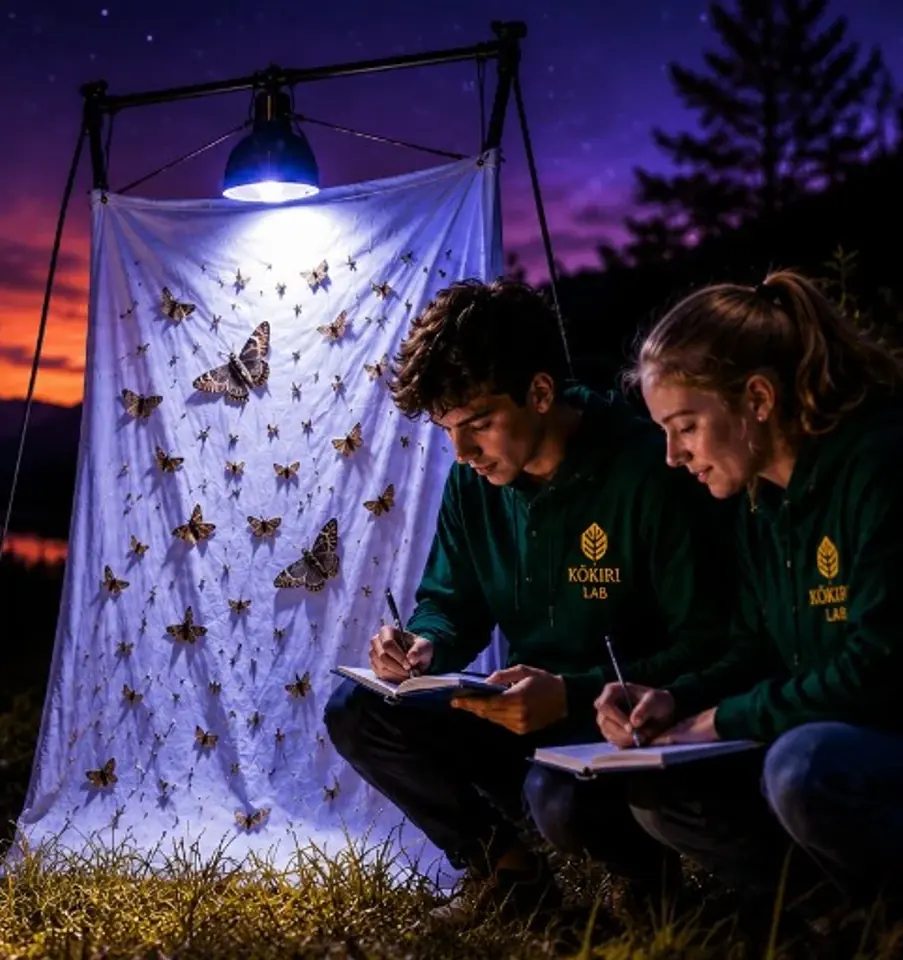
Share & impact · 01 · Observe · Community science · Biodiversity
Help monitor moths near your place
Set up a simple night-time light trap, photograph what lands, and add habitat notes. Moths feed birds and signal whether a place is healthy.
Open: Photo what lands on your trap; add habitat and weather notes. · School: Biodiversity & Discovery inquiry world
Where MaramaTrap fits in the curriculum
Local species records with AI-assisted identification. The AI's confidence is something students evaluate, not something they accept.
The open light-trap upload is live. The same dataset is revisited later as longitudinal evidence in Evolution & Adaptation.
Platforms are developed in response to curriculum and inquiry requirements, not the reverse.
Why your contribution matters
Most of New Zealand's moths are found nowhere else, yet no one has a long, steady record of how they are doing near where people live. Every photo you add, with honest notes about the place and the night, builds that record for Aotearoa.
- Your class, to compare habitats and test claims over time (Biodiversity & Discovery, then Evolution & Adaptation).
- Local restoration and predator-control groups, to see whether native insects are coming back.
- Researchers, who need many sites and many nights: more than any one scientist could ever cover.
Community missions
Pick a mission for your class, your family or a group of schools.
Dark night vs full Moon
Do moths really prefer dark nights? Find out with two sheets, two weeks apart.
- Run your sheet for an hour near the new Moon.
- Repeat near the full Moon, same place and time.
- Upload both nights with weather notes.
Garden vs bush edge
Is a native bush edge busier than a backyard? Pair up with another family or class.
- Two sheets, same night, two different habitats.
- Photograph every moth for one hour.
- Compare the families on each sheet.
- Summer
Big summer moth night
One night, many schools: a snapshot of moths across the region.
- Agree a date with other classes (a warm, calm evening in summer).
- Everyone runs a sheet from 9 pm to 10 pm.
- Upload the same night and look at the region map together.
For teachers and schools: work together
- Twin schools: pair with a school in a different kind of place (town and country, coast and hills) and compare your moth families each term.
- Share a 'same method' card so every class sets up the sheet, light and timing the same way. That is what makes comparisons fair.
- Invite whānau to a school moth night and present your class findings to them and to local conservation volunteers.
Take it further: bigger NZ projects
- Ahi Pepe MothNet
A schools moth project that started in Otago and now covers New Zealand.
- iNaturalist NZ – Mātaki Taiao
New Zealand's biggest nature-recording site, used by many schools (with a teacher account).
- Science Learning Hub: citizen science
Many more NZ projects your class can join, with teacher guides.
Share observations, not people: no names, no faces, no home addresses. A place nickname and region are enough.
How it works
Set trap → Upload → Identify → Contribute
Set trap
White sheet + UV torch after dark, away from competing lights.
Upload photo
Moth on plain white — fill the frame, no jar needed.
AI identification
Order/family level with honest confidence when unsure.
Contribute
Habitat notes turn a pretty photo into place-based evidence.
Show, don't just tell
Example good photo
- Place
- School garden edge
- Land use
- Urban green space
- Result
- Lepidoptera — medium confidence
Moth fills the frame on a plain white sheet. Habitat notes make it science, not just a gallery.
Borrowed from MaramaTrap's example-photo pattern — works for every platform.
Honest AI identification
MaramaTrap uses the same AI-assisted approach tested for a UCOL light-trap research study in Whanganui. It identifies moths at order level (for example, Lepidoptera) — not species — and tells you when it is not sure rather than guessing. That is a feature, not a flaw: you stay the human check on what the model suggests.
The model is still learning NZ-specific patterns. Family-level accuracy will improve as more trap photos are contributed — another reason to participate.
Read about the science & data →Learning & identification
Moths are ecological indicators. These resources support curious nights and careful science.
Host plants
Many NZ moths are tied to specific native plants — note what's growing nearby.
Seasonal activity
Warm still nights bring more visitors — log moon phase and weather.
Place notes
Forest edge, farm paddock, and urban garden host different communities.
17 moth families we are learning
The classifier is moving toward family-level IDs. When you correct a suggestion, pick from this list (spec 05).
Family-level only for now — not species claims (spec 03 §7). Corrections on your contributions help future training.
Good to know
Why place notes matter
Forest, farm, and garden host different moths. Your notes turn a photo into evidence.
AI honesty
The classifier says when it is not sure — that is a feature, not a failure.
At school?
MaramaTrap is the platform for the Biodiversity & Discovery inquiry world, and the same data is revisited later in Evolution & Adaptation. MaramaTrap community upload is open to everyone — no class code needed.
Also try community science
The same fair-testing habits work across platforms — honest notes, repeat visits, no street addresses.
AwaKai
Aquaponics water logs for growing food
Explore →NuiBot
Robots as research partners
Explore →SkyLab
Flight school & biomimicry logs
Explore →KāingaLab
Model-home fair tests for Ecohome & Design
Explore →AraQuest
Build a world, test how it behaves
Explore →