
Kōkiri Lab · Share & impact · Community science
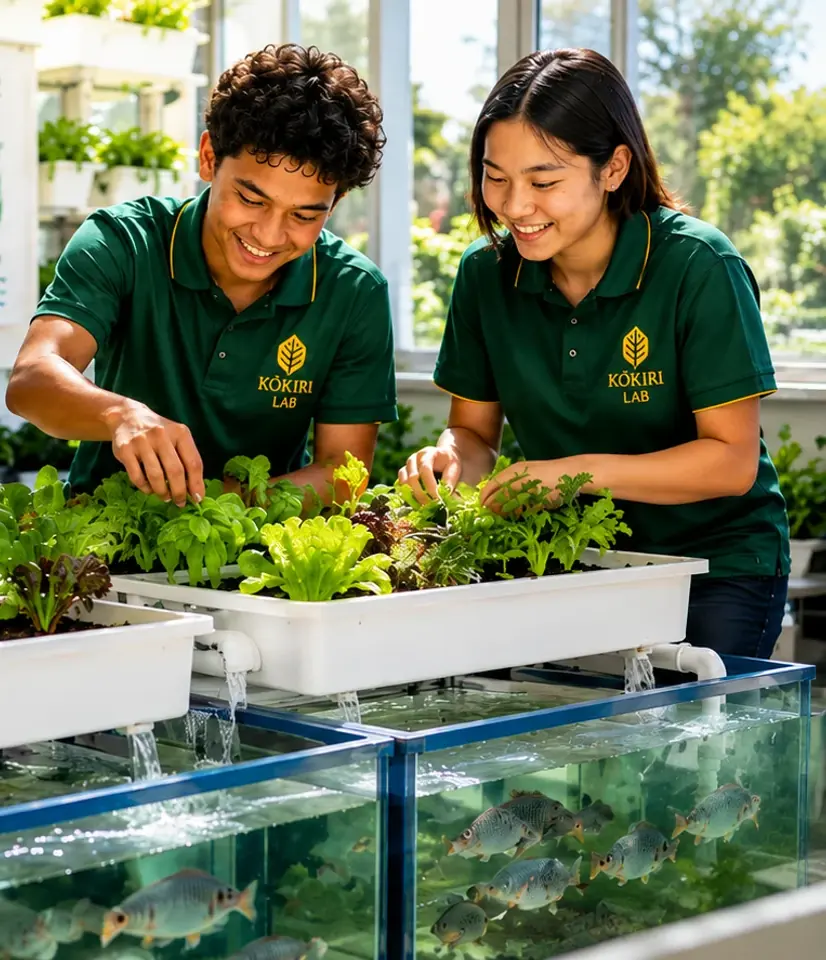
Share & impact · 02 · Measure · Community science · Aquaponics & food growing
Grow food with living water
Log weekly readings from your aquaponics tank — pH, temperature, and notes — so schools and whānau can learn what keeps fish and plants thriving together.
Open: Tank readings with a place nickname — no stream visits required. · School: Ecosystem Health & Restoration inquiry world
One platform, two modes
First understand a system. Then help it thrive.
AwaKai's dual use, diagnostic in Ecosystem Health & Restoration and design-oriented in Regenerative Systems & Living, is a curriculum progression, understanding leading to intervention, not simply a platform feature.
Why your contribution matters
Healthy water is the heart of healthy land. Regular, careful readings from tanks and streams show what is changing and when: the kind of evidence councils, iwi and catchment groups need to decide what to do.
- Your class, to diagnose a system and test a restoration idea (Ecosystem Health & Restoration, then Regenerative Systems & Living).
- Other schools running AwaKai tanks, comparing what keeps fish and plants thriving.
- Local catchment and restoration groups interested in stream health.
Community missions
Pick a mission for your class, your family or a group of schools.
Same time every week
One reading a week, same time and spot, for a whole term: the simplest way to spot real change.
- Pick a day and time and stick to it.
- Record temperature and pH, plus anything you notice.
- At the end of term, graph it and look for a pattern.
Temperature through the day
How much does the water warm up from morning to afternoon?
- Take readings at the start of school, lunch and home time.
- Repeat on 3 days with different weather.
- Explain what you find using sunlight and shade.
Mystery cloudiness
The tank has gone cloudy. What changed?
- Record what happened in the last 2 days (feeding, sun, cleaning).
- Take readings and a clarity photo.
- Share your best explanation, and how sure you are.
For teachers and schools: work together
- Tank buddies: pair with another school's AwaKai tank and swap readings each fortnight. Whose system is more stable, and why?
- Agree on the same measuring steps so your numbers can be compared.
- Invite a council freshwater officer or catchment group to hear your stream health findings.
Take it further: bigger NZ projects
- NIWA SHMAK stream health kit
The kit schools, iwi and community groups use to monitor stream health. Many regional councils lend it out.
- Landcare Trust
Community catchment groups around New Zealand you could connect with.
- Science Learning Hub: citizen science
Many more NZ projects your class can join, with teacher guides.
Share observations, not people: no names, no faces, no home addresses. A place nickname and region are enough.
How it works
Sample → Measure → Submit → Compare
Sample
Same tank spot each week — mid-depth, after fish settle.
Measure
pH and temperature with a rinsed probe or honest strip reading.
Submit
Place nickname and region only — note feeding and what you observed.
Compare
Patterns over weeks beat one lucky number — compare like with like.
Show, don't just tell
Example reading card
- Place
- Room 12 aquaponics
- pH / temp
- 7.1 · 22 °C
- Source
- Aquaponics tank
Same spot each week. Note feeding yesterday and probe (not strips) in your notes.
Borrowed from MaramaTrap's example-photo pattern — works for every platform.
Growing with science
Aquaponics links fish, plants, and water chemistry. These ideas help you read your numbers and grow better food.
Nitrogen cycle
Fish waste → ammonia → nitrite → nitrate → plant uptake. Stuck at ammonia? Note it.
pH for tanks
Many school systems target roughly 6.8–7.2 — compare your trend, not someone else's stream.
Food production
Healthy water grows healthy greens — log when you harvest and what changed that week.
Good to know
pH for tanks
Many school aquaponics systems sit around 6.8–7.2 — track your trend, not someone else's awa.
Nitrogen cycle
Fish waste → ammonia → nitrite → nitrate → plants. Stuck at ammonia? Note it and ask why.
Growing food
Healthy water grows healthy greens — log harvest weeks to connect chemistry and production.
Where AwaKai fits in the curriculum
One platform, two modes. Diagnostic mode asks whether a system is healthy; design mode asks whether an intervention helped. That shift, from understanding to intervention, is a curriculum progression, not just a feature.
Both modes use the same open water-reading log: place, region, water source, pH, temperature and notes.
Platforms are developed in response to curriculum and inquiry requirements, not the reverse.
Also try community science
The same fair-testing habits work across platforms — honest notes, repeat visits, no street addresses.
MaramaTrap
Community moth monitoring for Aotearoa
Explore →NuiBot
Robots as research partners
Explore →SkyLab
Flight school & biomimicry logs
Explore →KāingaLab
Model-home fair tests for Ecohome & Design
Explore →AraQuest
Build a world, test how it behaves
Explore →