
Causal and systemic explanation
- Starting out
- Identify relationships.
- Going further
- Explain interactions, feedback, unintended consequences and system-level effects.
World 06 · Any term · Combined Year 7–8 class
How can we design a home that works for people and place?
Your mission
Warm Whare Challenge: design a home that works for people and place.
What you'll make
A model home tested for warmth, improved once, and explained with evidence.
Who it's for
A local builder or architect, a housing provider, and whānau
How long
About nine one-hour sessions, in any term. It can be shorter or longer.
NZ curriculum, Years 7–8:Science: Matter Interactions and EnergyTechnology: Materials TechnologyTechnology: Design, Make, and Innovate· Topics: heat transfer, insulation, energy-efficient homes, passive solar design, materials testing, design technology, warm dry homes
Your journey
Tap a week to see that lesson. Each world runs as nine one-hour weeks; it can be shortened to five weeks or stretched to 11–12.
Week 1Open →
Warm, dry homes
Ask · Look closely
VOICE Question · Observe
Week 2Open →
How heat moves
Look closely · Collect evidence
VOICE Observe · Evidence
Week 3Open →
Fair test
Collect evidence · Compare
VOICE Evidence · Compare
Week 4Open →
Homes as systems
Make sense of it · How sure are we?
VOICE Interpret · Uncertainty
Week 5Open →
Brief and functional model
Say what we found · Decide what's next · Define the problem · Come up with ideas · Sketch the plan
VOICE Finding · Next step → FORGE Frame · Options · Represent
Week 6Open →
Build v1
Build it · Test it
FORGE Generate · Test
Week 7Open →
What failed?
Judge it · Improve it
FORGE Evaluate · Refine
Week 8Open →
Final test and justification
Test it · Improve it
FORGE Test · Refine
Week 9Open →
Share
Explain and share
FORGE Explain
5 weeks
Quick build
A fair test of insulation materials and a recommendation for a real home.
9 weeks
Full journey
A model home tested for warmth, redesigned once, with a design justification.
11–12 weeks
Go further
Window and daylight design, laser-cut or 3D-printed parts, or advice for a real building.
Big ideas
A home is a system of interacting subsystems: thermal, structural and electrical.
Material properties and construction techniques together determine how well an outcome performs.
Good design balances user needs, environmental impact and material performance.
Up close
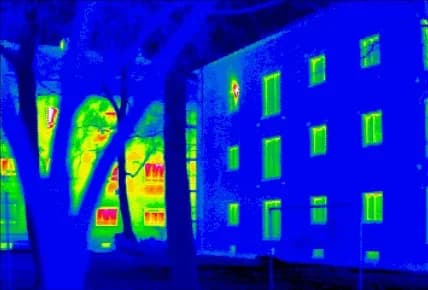
A thermal camera shows heat escaping: the building on the left glows (heat leaking out), the insulated one on the right stays cool.
Photo: Passivhaus Institut, CC BY-SA 3.0, via Wikimedia Commons
Read first
Energy efficiency means using less energy to get the same comfort and convenience. A warm, bright house that needs less heating is more efficient than one that needs a heater running all day. There are two ways to get there: better technology (such as insulation or efficient heaters) and changing how people behave.
Buildings matter. One set of course figures says buildings use about 42% of all energy and about 25% of all water.
Think about it: Name one change to technology and one change to behaviour that would save energy in your classroom.
Source: Massey "Introduction to Energy Efficient Buildings", Topic 1 slides.
A passive solar home uses the Sun's free energy to stay warm, with no machines. There are five principles:
Think about it: Why do deciduous trees (trees that lose their leaves) make good shading for a north-facing window?
Source: Massey "Energy Efficient Buildings" Topic 1; Regenpreneur PDC "EcoHome Design".
An ecohome saves water in three ways:
Think about it: Which of these could our school try first? What would we measure to show it worked?
Source: Regenpreneur PDC "EcoHome Design".
In a WIS project, students researched Earthships, homes designed to provide their own food, water and power. They split into expert groups: producing food and water, building the house, managing waste and water use, and creating electricity. Then they designed an Earthship for a New Zealand beach. One idea was aquaponics inside the home: fish waste feeds the plants, and the plants clean the water for the fish.
Think about it: A home is a system of subsystems (heat, water, power, food). Pick two. How does a change in one affect the other?
Source: WIS 2024 "Earthship Design Research Project".
Go deeper: from Science Learning Hub and DOC
Temperature measures the average energy of the particles in something. The faster they move, the hotter it feels.
Heat always moves from hotter things to colder things, in three ways:
Insulation slows heat moving from one place to another. Trapping air in layers works very well, which is how penguin feathers keep penguins warm, and how wool, batts and double glazing keep homes warm.
Some energy sources can be replaced quickly: solar, wind, water, geothermal and bioenergy. A solar oven uses insulation, reflection and absorption together.
Think about it: In your model home, where will heat escape by conduction, by convection and by radiation? Which will you fix first?
Adapted for Kōkiri Lab from “Physical world: heat”. Source: Science Learning Hub – Pokapū Akoranga Pūtaiao, The University of Waikato Te Whare Wānanga o Waikato, www.sciencelearn.org.nz Read the original
Explore more
These links open other websites. Kōkiri Lab checked them in September 2026.
How you'll learn
What evidence can we gather?
Students encounter the phenomenon, build the knowledge needed to interpret it, and gather evidence directly.
This is not a strict pipeline. A student may investigate, model, test, investigate again, revise, and communicate, in whatever order the actual inquiry demands.
Make something
Science investigations
VOICE: ask a question and find out with evidence
You need
identical cups · warm water (teacher pours) · thermometers · wool, foil, bubble wrap, newspaper
Steps
How you'll know: The slowest-cooling cup has the best insulator. The unwrapped cup is your comparison.
The teacher handles hot water.
Go further: Test two thicknesses of the best material.
Fits Week 3 →You need
thermometer · tissue strip · room plan
Steps
How you'll know: Your map shows the coldest spots and draughts: the first places to fix.
Go further: Compare morning and afternoon.
Fits Week 2 →You need
2 shoebox 'rooms' · cling-film windows · lamp or sun · thermometers
Steps
How you'll know: The box whose window faces the sun warms faster. That is why NZ homes put windows on the north.
Go further: Add eaves (card) and test on a 'summer' (high) sun angle.
Fits Week 4 →Build projects
FORGE: design, make, test and improve
You need
cardboard · insulation offcuts · low-temp glue gun · lamp · thermometers
Steps
How you'll know: Version 2 beats version 1 and meets your specification.
Low-temp glue guns and craft knives only with supervision.
Go further: Beat your own model by 2 °C.
Fits Week 6 →You need
microcontroller · temperature sensor · LED or buzzer
Steps
How you'll know: It switches on at the right temperature every time.
Go further: Add a second level: warn, then alarm.
Fits Week 7 →You need
design software · laser cutter (teacher-run) · card or ply
Steps
How you'll know: The parts fit without gaps, which helps insulation too.
Only the teacher operates the laser cutter.
Go further: Design a window that can open for ventilation.
Fits Week 6 →More ideas from the Kōkiri library
Background learning
Earlier Kōkiri inquiries with learn pages, activities and build ideas that fit this world. They were written before the eight-world curriculum, so use them as background and pick what helps.
Makerspace build ideas
Ready-made ideas from the Kōkiri maker library that suit the Make & Test part of this world.
Stretch challenges
Where AI helps
Kōkako, your AI mentor
Weeks 3 and 7
Our AI promise
Your platform
The specialist platform for this world's material tests and functional home models.
This section introduces the platform. Its tools are still being built.
Open KāingaLabTaught to the whole combined class. Over the two-year programme the class covers both the Year 7 and Year 8 curriculum statements.
The whole combined Year 7–8 class investigates the same phenomenon, with the same fieldwork, equipment and inquiry problem. Instead of splitting the class by year level, every task has three levels of support (Getting started, On track, Stretch), so each learner goes as deep as they are ready to.
A home is a system of interacting subsystems, and explaining how they affect one another is central to good design.
All five dimensions recur across every world. Each world provides a context in which one or more becomes especially visible, not an exclusive assignment.
Document 33 stage names, used across Kōkiri. The week plan above shows which stages each week works in.
Te reo groupings shown are provisional, pending cultural advisor review.
Mainly in STEM Investigate and Think & Create.
Kite · te reo group (provisional)
Whakaaro · te reo group (provisional)
Mainly in Make & Test, ending with Explain in Share & Impact.
Wero · te reo group (provisional)
Kite · te reo group (provisional)
Whakaaro · te reo group (provisional)
Auaha · te reo group (provisional)
Tohu · te reo group (provisional)
Māori housing and pā, colonial housing, railway houses and state housing nationally; local housing history and materials specific to Whanganui.