
Causal and systemic explanation
- Starting out
- Identify relationships.
- Going further
- Explain interactions, feedback, unintended consequences and system-level effects.
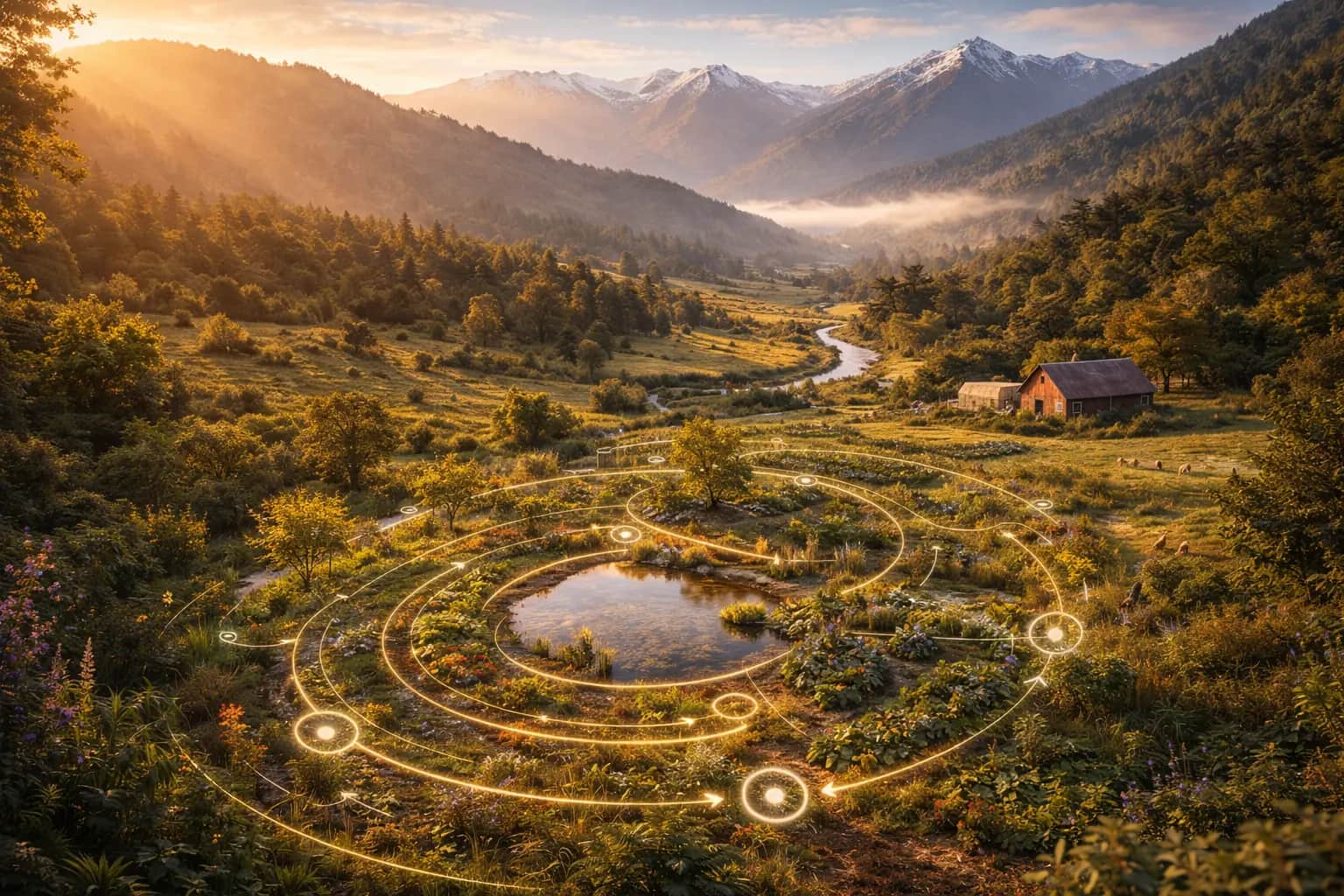
World 07 · Any term · Combined Year 7–8 class
How can human systems help living systems thrive?
Your mission
Grow It Better: design a garden that helps life thrive.
What you'll make
A planted garden idea with a tested prediction, and an honest report of what happened, including surprises.
Who it's for
The school community, whānau and a community garden
How long
About nine one-hour sessions, in any term. It can be shorter or longer.
NZ curriculum, Years 7–8:Science: EcosystemsScience: Life ProcessesTechnology: Design, Make, and Innovate· Topics: permaculture, school gardens, soil science, pollination, seeds and plants, composting, regenerative design
Your journey
Tap a week to see that lesson. Each world runs as nine one-hour weeks; it can be shortened to five weeks or stretched to 11–12.
Week 1Open →
Reading the site
Ask · Look closely
VOICE Question · Observe
Week 2Open →
Observe like a designer
Look closely · Collect evidence
VOICE Observe · Evidence
Week 3Open →
Living soil and the ethics filter
Collect evidence · Compare · Make sense of it
VOICE Evidence · Compare → Interpret
Week 4Open →
Design and prediction
Say what we found · Decide what's next · Define the problem · Come up with ideas · Sketch the plan
VOICE Finding · Next step → FORGE Frame · Options · Represent
Week 5Open →
Build and plant
Build it
FORGE Generate
Week 6Open →
Flowers, pollinators and seeds
Look closely · Make sense of it · How sure are we?
VOICE Observe · Interpret · Uncertainty
Week 7Open →
Monitoring 1
Test it · Judge it
FORGE Test · Evaluate
Week 8Open →
Monitoring 2 and consequences
Judge it · Improve it
FORGE Evaluate · Refine
Week 9Open →
Report and fair share
Explain and share
FORGE Explain
5 weeks
Quick build
A seed-tray fair test (compost or none, mulch or bare) with a planting tip for the school garden.
9 weeks
Full journey
A designed garden with a comparison plot, monitoring, a consequences log and a garden report.
11–12 weeks
Go further
A fruit-tree guild, a seed library, or handing the garden on to next term.
Big ideas
Human systems can be designed to support, not just use, living systems.
Intervening in a system has consequences that need to be predicted and checked.
Regenerative design applies the same systemic reasoning used to diagnose ecosystem health.
Up close
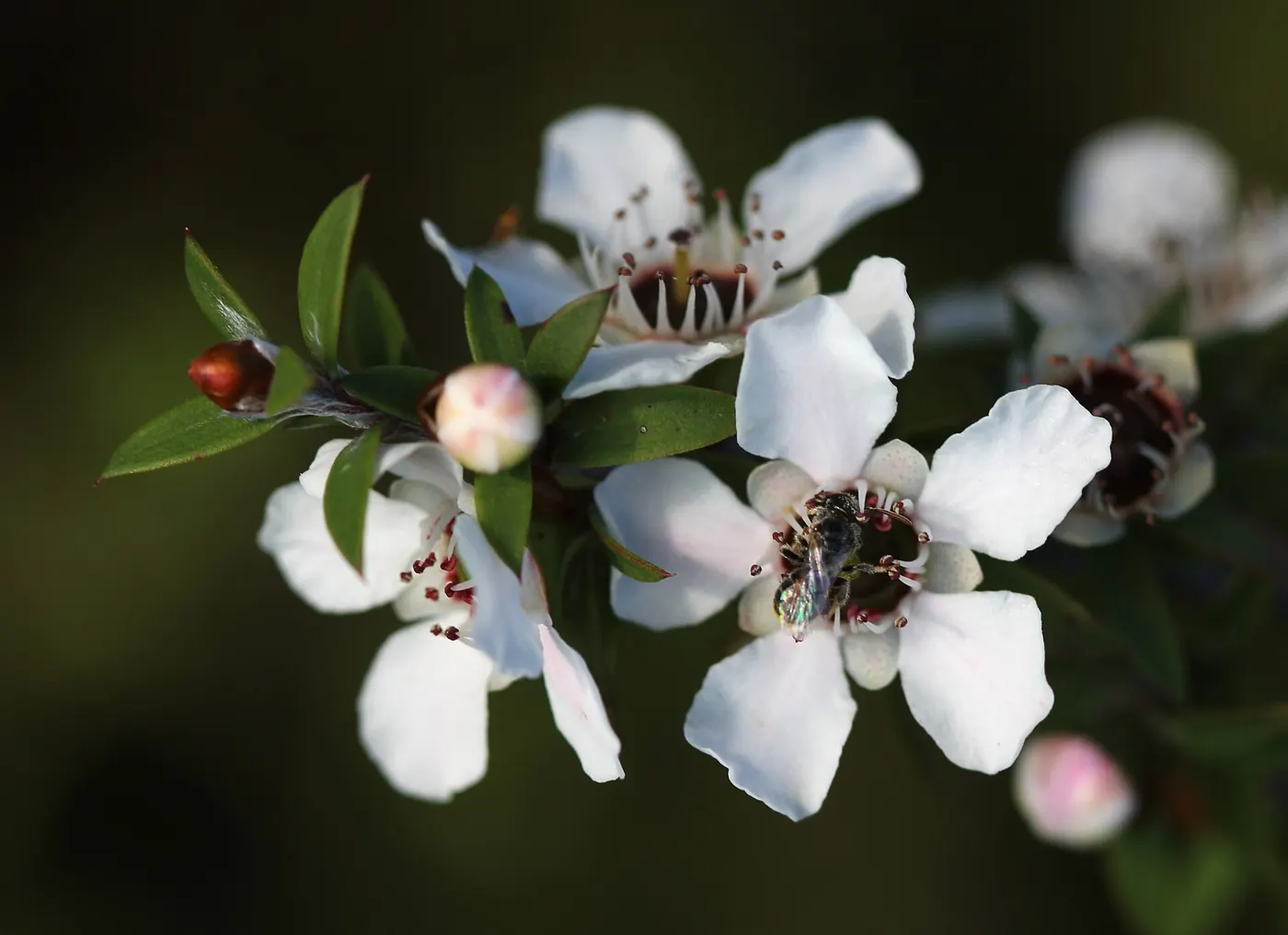
A native bee on mānuka flowers: pollination in action.
Photo: Avenue, CC BY-SA 3.0, via Wikimedia Commons
Read first
Nature has been designing working systems for millions of years, so a regenerative designer's first job is not to change a place, but to understand it. Good designers, scientists and community leaders share one skill: they notice things others overlook.
Ways to read the land:
Think about it: Walk the garden site for five minutes without talking. What did you notice that you had never noticed before?
Source: Kōkiri Learn "Regenerative Changemakers: Read the Land" (Folder 25).
Soil starts as weathered rock, broken into tiny mineral pieces: sand, silt and clay. What turns this into living, fertile soil is organic matter, which comes from rotted plants and animals.
Organic matter glues soil particles into crumbs (aggregates) with spaces for air and water. That helps roots grow and soil life thrive. New Zealand has many soil types, from sandy coastal soils to heavy volcanic clays.
Think about it: Squeeze a handful of garden soil. Does it crumble or stay in a sticky lump? What might that tell you?
Source: Regenpreneur PDC "Building Healthy Soil".
When leaves, roots and manure die, soil life breaks them down. Fungi and bacteria do the first breakdown. Then earthworms and insects break the material down further. The result is humus, a dark, stable material that holds water and nutrients.
Adding compost, mulch and cover crops ("green manure") keeps feeding this cycle. Organic matter also stores carbon in the soil.
Think about it: Why might a garden bed covered in mulch have more earthworms than bare soil?
Source: Regenpreneur PDC "Building Healthy Soil".
Permaculture design rests on three ethics: Earth care, people care and fair share. A regenerative garden should leave the land healthier than before (earth care), be good for the people who use it (people care), and share its surplus, such as seeds, seedlings, food and knowledge (fair share).
Think about it: How will our garden project show all three ethics? Which one is hardest?
Source: Regenpreneur PDC "EcoHome Design" introduction and "Permaculture Design Principles".
Go deeper: from Science Learning Hub and DOC
Pollination moves pollen from one flower to another so the plant can make seeds and fruit. Some plants can pollinate themselves (self-pollination); many need pollen from another plant (cross-pollination).
Pollinators in Aotearoa include:
Pollination matters for food: kiwifruit growers depend on it, and scientists are working on bee-friendly insecticides and even pollination robots.
Think about it: What could our garden add to attract more pollinators, and how would we count whether it worked?
Adapted for Kōkiri Lab from “Pollination”. Source: Science Learning Hub – Pokapū Akoranga Pūtaiao, The University of Waikato Te Whare Wānanga o Waikato, www.sciencelearn.org.nz Read the original
Aotearoa has more than 200 kinds of earthworm, and most of them are native: found nowhere else. One native worm, Octochaetus multiporus, can grow to 30 cm long and glows when it is disturbed.
Earthworms are called ecosystem engineers because they change the soil around them:
When forests were cleared for farming, many native earthworms disappeared from those soils.
Think about it: Count the earthworms in a spadeful of soil from two different beds. What might explain a difference?
Adapted for Kōkiri Lab from “Earthworms' role in the ecosystem”. Source: Science Learning Hub – Pokapū Akoranga Pūtaiao, The University of Waikato Te Whare Wānanga o Waikato, www.sciencelearn.org.nz Read the original
Explore more
These links open other websites. Kōkiri Lab checked them in September 2026.
How you'll learn
What evidence can we gather?
Students encounter the phenomenon, build the knowledge needed to interpret it, and gather evidence directly.
This is not a strict pipeline. A student may investigate, model, test, investigate again, revise, and communicate, in whatever order the actual inquiry demands.
Make something
Science investigations
VOICE: ask a question and find out with evidence
You need
two garden patches or trays · mulch · thermometer · moisture meter or 'squeeze test'
Steps
How you'll know: If the mulched patch stays wetter and cooler, your prediction is supported. Note other differences.
Go further: Count earthworms in each patch at the end.
Fits Week 7 →You need
timer · tally sheet · flowering plants
Steps
How you'll know: Compare visitors per 10 minutes. Note the weather and time.
Go further: Plant more of the winning flower near the vegetables.
Fits Week 6 →You need
seed trays · potting mix · compost · seeds (e.g. beans) · ruler
Steps
How you'll know: Compare the averages. Did compost help, and how sure are you?
Go further: Test a third mix, e.g. worm castings.
Fits Week 1 →Build projects
FORGE: design, make, test and improve
You need
cardboard · compost · mulch · seedlings · gloves
Steps
How you'll know: The bed is planted, labelled and has a comparison plot to monitor.
Gloves for potting mix and compost. Wash hands after.
Go further: Design a four-bed rotation for next year.
Fits Week 5 →You need
microcontroller · soil moisture sensor · LED
Steps
How you'll know: The light matches what you feel with your fingers.
Go further: Log readings for a week and graph them.
Fits Week 7 →You need
envelopes · labels · saved seeds · a box
Steps
How you'll know: Other people take seeds and know how to grow them.
Go further: Ask borrowers to return seeds from their plants.
Fits Week 9 →More ideas from the Kōkiri library
Background learning
Earlier Kōkiri inquiries with learn pages, activities and build ideas that fit this world. They were written before the eight-world curriculum, so use them as background and pick what helps.
Makerspace build ideas
Ready-made ideas from the Kōkiri maker library that suit the Make & Test part of this world.
Stretch challenges
Where AI helps
Kōkako, your AI mentor
Weeks 7–8, while you monitor
Our AI promise
Your platform
Design mode: plan an intervention, predict its effect, then check it with evidence.
Both modes use the same open water-reading log: place, region, water source, pH, temperature and notes.
Open AwaKaiTaught to the whole combined class. Over the two-year programme the class covers both the Year 7 and Year 8 curriculum statements.
The whole combined Year 7–8 class investigates the same phenomenon, with the same fieldwork, equipment and inquiry problem. Instead of splitting the class by year level, every task has three levels of support (Getting started, On track, Stretch), so each learner goes as deep as they are ready to.
The same systemic reasoning developed in Ecosystem Health is now applied to a designed rather than only observed system.
All five dimensions recur across every world. Each world provides a context in which one or more becomes especially visible, not an exclusive assignment.
Document 33 stage names, used across Kōkiri. The week plan above shows which stages each week works in.
Te reo groupings shown are provisional, pending cultural advisor review.
Mainly in STEM Investigate and Think & Create.
Kite · te reo group (provisional)
Whakaaro · te reo group (provisional)
Mainly in Make & Test, ending with Explain in Share & Impact.
Wero · te reo group (provisional)
Kite · te reo group (provisional)
Whakaaro · te reo group (provisional)
Auaha · te reo group (provisional)
Tohu · te reo group (provisional)
Māra kūmara, historical and contemporary food systems, and regenerative agriculture nationally.