
Comparative reasoning
- Starting out
- Identify similarities and differences.
- Going further
- Compare explanations or models and justify which better accounts for the evidence.
World 05 · Any term · Combined Year 7–8 class
How do populations change over time?
Your mission
Survivors: how do populations change?
What you'll make
An explanation of why a species like the moa disappeared, and a verdict on whether an earlier claim about variation still holds.
Who it's for
Your class and a conservation group
How long
About nine one-hour sessions, in any term. It can be shorter or longer.
NZ curriculum, Years 7–8:Science: Organism Diversity· Topics: evolution, natural selection, adaptation, fossils, extinction, moa, kākā, kea and kākāpō, variation
Your journey
Tap a week to see that lesson. Each world runs as nine one-hour weeks; it can be shortened to five weeks or stretched to 11–12.
Week 1Open →
Stories in stone
Ask · Look closely
VOICE Question · Observe
Week 2Open →
Reading fossils
Collect evidence · Make sense of it
VOICE Evidence · Interpret
Week 3Open →
Variation everywhere
Look closely · Collect evidence
VOICE Observe · Evidence
Week 4Open →
Selection model
Compare
VOICE Compare
Week 5Open →
Does our old claim hold?
Make sense of it · How sure are we? · Say what we found
VOICE Interpret · Uncertainty · Finding
Week 6Open →
Change the conditions
Build it · Test it
FORGE Generate · Test
Week 7Open →
Parrots and a shared ancestor
Compare · Make sense of it
VOICE Compare · Interpret
Week 8Open →
Why did moa disappear?
Judge it · Improve it
FORGE Evaluate · Refine
Week 9Open →
Share
Explain and share
FORGE Explain
5 weeks
Quick build
A paper-moth selection model, a graph and an explanation of natural selection.
9 weeks
Full journey
Read fossils, test a selection model under a new condition, retest a MaramaTrap claim and explain an extinction.
11–12 weeks
Go further
A digital selection model in Scratch, a kākāpō conservation brief, or sharing with a conservation group.
Big ideas
Fossils and other evidence show that organisms have changed over Earth's history.
Heritable variation, combined with selection pressures, drives change in populations over generations.
Evolution describes change in populations over generations, not within individuals.
Up close
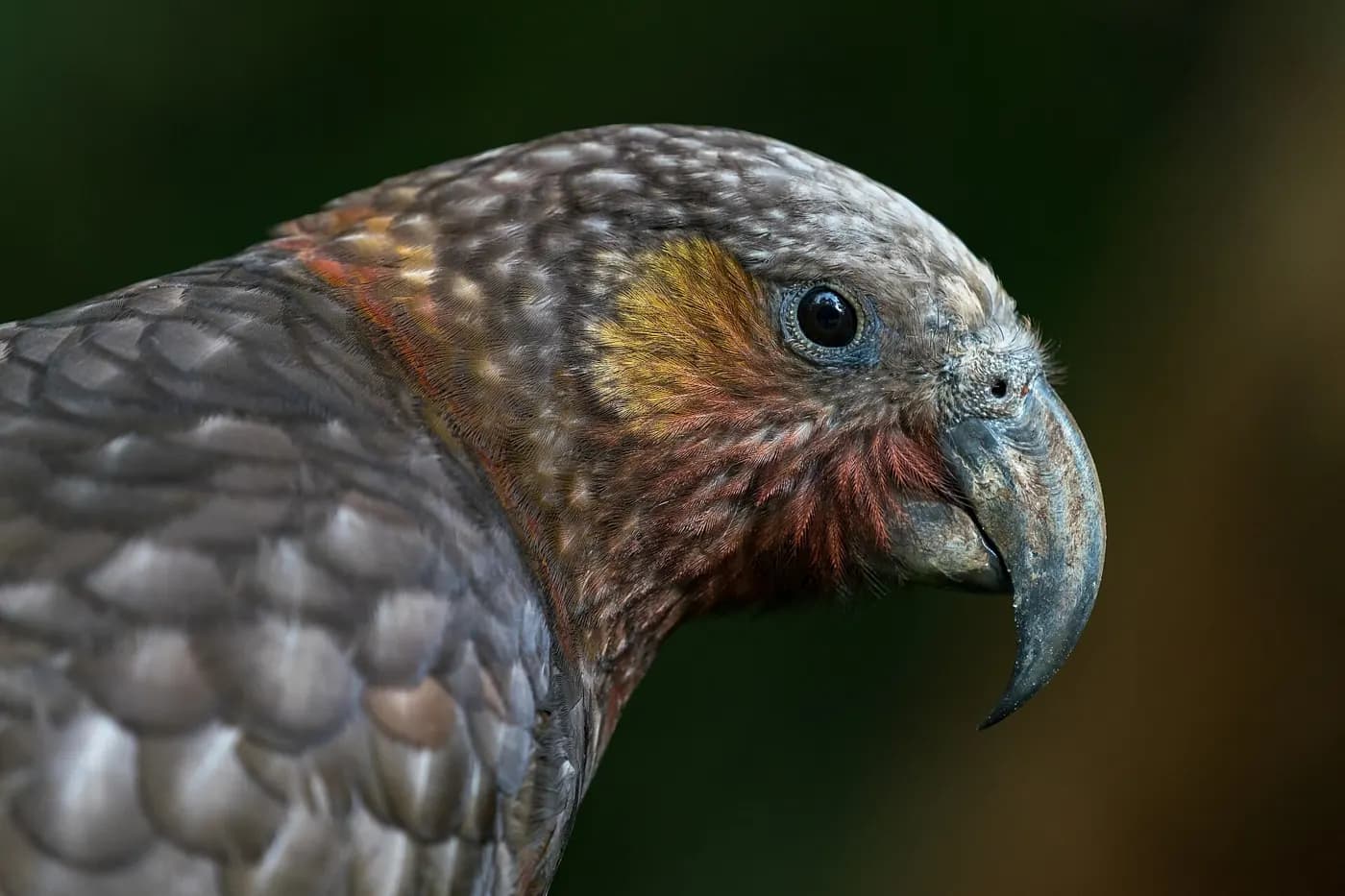
A kākā up close. Compare its beak with a kea's and a kākāpō's.
Photo: Judi Lapsley Miller, CC BY 4.0, via Wikimedia Commons
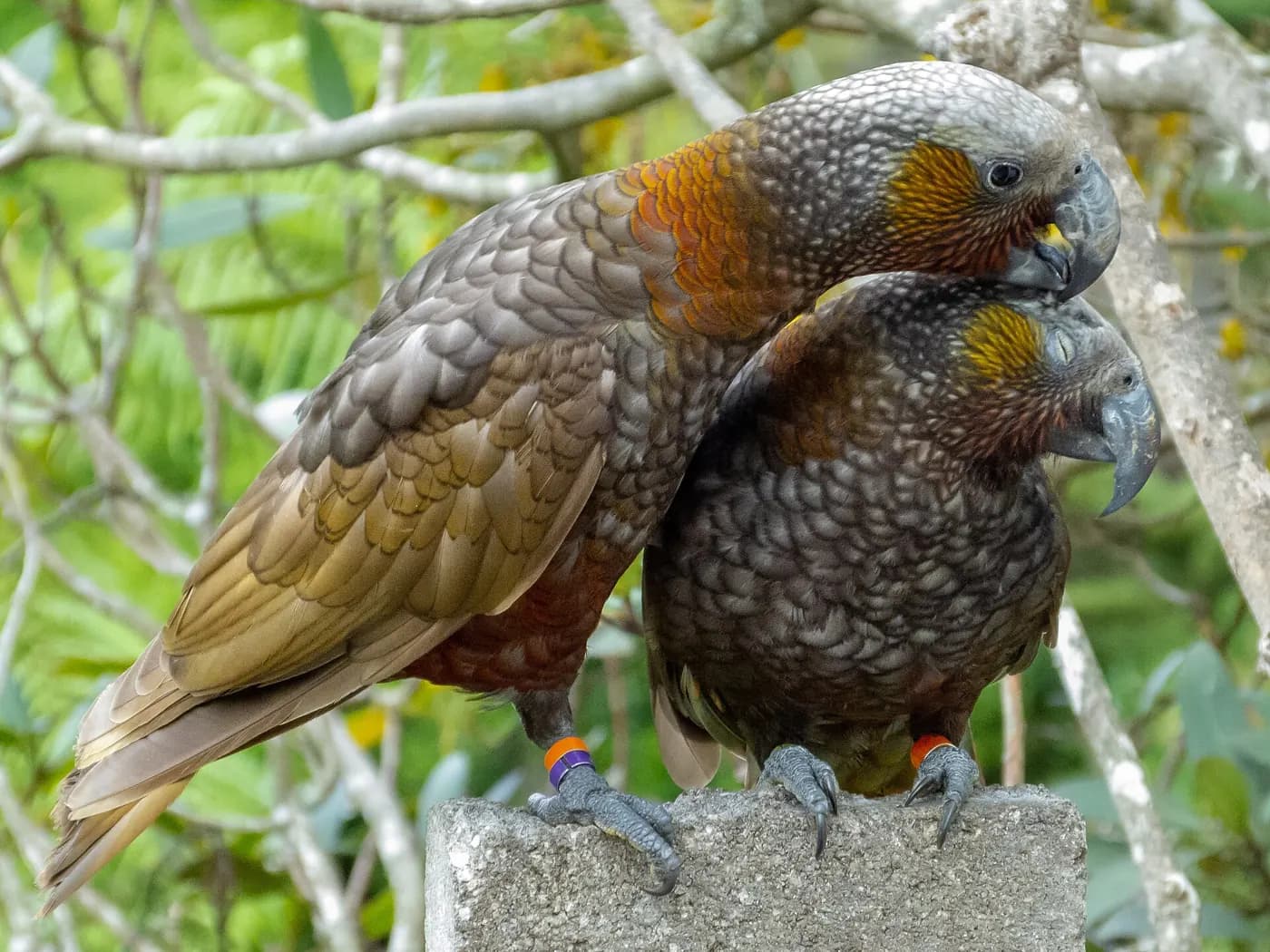
Two North Island kākā preening each other.
Photo: Judi Lapsley Miller, CC BY 4.0, via Wikimedia Commons
Read first
New Zealand was separated from other land for about 80 million years. Many groups of animals that live elsewhere never arrived: no land mammals except bats, no snakes. So birds took on many roles, and many species evolved here that are found nowhere else (they are endemic).
The top predators were birds too. Haast's eagle was huge (females 10–15 kg) and could kill moa weighing up to about 40 kg. Other hunters included a large harrier (Eyles's harrier) and the laughing owl.
Think about it: If the only predators hunt by sight from the air, what features would help a ground bird survive?
Source: Massey lecture "The arrival and impact of Homo sapiens in Aotearoa New Zealand" (M. Anderson).
For millions of years, many New Zealand birds (kākāpō, takahē, kiwi, whio and others) survived eagle attacks with camouflage and by freezing still. If the eagle couldn't see movement, it couldn't find them. That was an adaptation that worked.
Then, in the last 2,000 years, mammal predators arrived: rats, and later stoats, ferrets, cats and others. These hunt by smell and sound as well as sight. Freezing doesn't help if a stoat can smell you. An adaptation that worked for millions of years suddenly failed.
Think about it: Is an adaptation "good" forever? Explain using the freezing example.
Source: Massey lecture "The arrival and impact of Homo sapiens in Aotearoa New Zealand".
Conservation in Aotearoa uses three kinds of action: protecting the habitat that is left (about 30% of the land is now in reserves, but more than 90% of wetlands are gone), managing endangered species, and restoring places through pest control, replanting and moving species back.
Islands have been vital. There are 337 islands bigger than 5 hectares, and many are safe from predators. Moving animals to a safe place is called translocation. Around 1900, conservation ranger Richard Henry moved kiwi and kākāpō to Resolution Island in Fiordland. More recently, the North Island saddleback went from a single island population of about 500 birds in the early 1900s to 15 island populations and 3 mainland populations by 2013. The Chatham Island black robin and the takahē are other species brought back from the brink.
Think about it: Every saddleback today comes from one small island population. How might that affect the variation in the species? (This is a question to investigate, not an answer.)
Source: Massey lecture "Back from the brink in Aotearoa New Zealand".
One more reading draws on mātauranga Māori and will appear once our cultural advisor has checked it.
Go deeper: from Science Learning Hub and DOC
An adaptation is a feature that helps a living thing survive and reproduce where it lives. There are three kinds:
| Kind | What it means | Native bird examples |
|---|---|---|
| Structural | Body parts | Kiwi have nostrils at the tip of the beak for sniffing out food, and whiskers for feeling in the dark. Tūī have a long curved beak and a brush-tipped tongue for nectar. Kererū have the widest mouths of our forest birds, so they can swallow and spread big seeds |
| Behavioural | Things they do | Kiwi are active at night. Kākāpō breed in years when rimu trees produce lots of fruit |
| Physiological | How their bodies work inside | Kererū parents make “crop milk”, a protein-rich food for their chicks |
With no ground-hunting mammals for tens of millions of years, some birds, such as kiwi and takahē, lost the need to fly. Their wings became small and their bodies large.
When people arrived, bringing predators and clearing forest, many of these adaptations stopped protecting them.
Think about it: Pick one adaptation from the table. In what kind of world is it a strength, and in what kind of world does it become a weakness?
Adapted for Kōkiri Lab from “Native bird adaptations”. Source: Science Learning Hub – Pokapū Akoranga Pūtaiao, The University of Waikato Te Whare Wānanga o Waikato, www.sciencelearn.org.nz Read the original
Explore more
These links open other websites. Kōkiri Lab checked them in September 2026.
How you'll learn
What evidence can we gather?
Students encounter the phenomenon, build the knowledge needed to interpret it, and gather evidence directly.
This is not a strict pipeline. A student may investigate, model, test, investigate again, revise, and communicate, in whatever order the actual inquiry demands.
Make something
Science investigations
VOICE: ask a question and find out with evidence
You need
paper 'moths' in two colours · patterned background · timer
Steps
How you'll know: Graph each colour over time. The better-camouflaged colour should increase.
Go further: Change the background. Does the winner change?
Fits Week 4 →You need
20+ leaves or shells · ruler or callipers
Steps
How you'll know: Your graph shows the spread. Most are near the middle, with a few at each end.
Go further: Compare two different trees or beaches.
Fits Week 3 →You need
tools as 'beaks' (tweezers, pegs, spoons) · foods (seeds, water in a tube, rice)
Steps
How you'll know: You can explain why a beak shape suits a food, using your results.
Go further: Invent a bird for a new food, and draw its beak.
Fits Week 7 →Build projects
FORGE: design, make, test and improve
You need
card or Scratch
Steps
How you'll know: Players can see the population change over rounds.
Go further: Build it as a digital model in Scratch.
Fits Week 6 →You need
evidence cards or readings · poster or slides
Steps
How you'll know: Each claim on your explainer points to evidence.
Go further: Connect it to a species at risk today.
Fits Week 8 →You need
trait cards · paper
Steps
How you'll know: Your tree matches your trait table, and you can say what evidence would change it.
Go further: Add a fourth bird and place it.
Fits Week 7 →More ideas from the Kōkiri library
Background learning
Earlier Kōkiri inquiries with learn pages, activities and build ideas that fit this world. They were written before the eight-world curriculum, so use them as background and pick what helps.
Makerspace build ideas
Ready-made ideas from the Kōkiri maker library that suit the Make & Test part of this world.
Stretch challenges
Where AI helps
Kōkako, your AI mentor
Weeks 5 and 8
Our AI promise
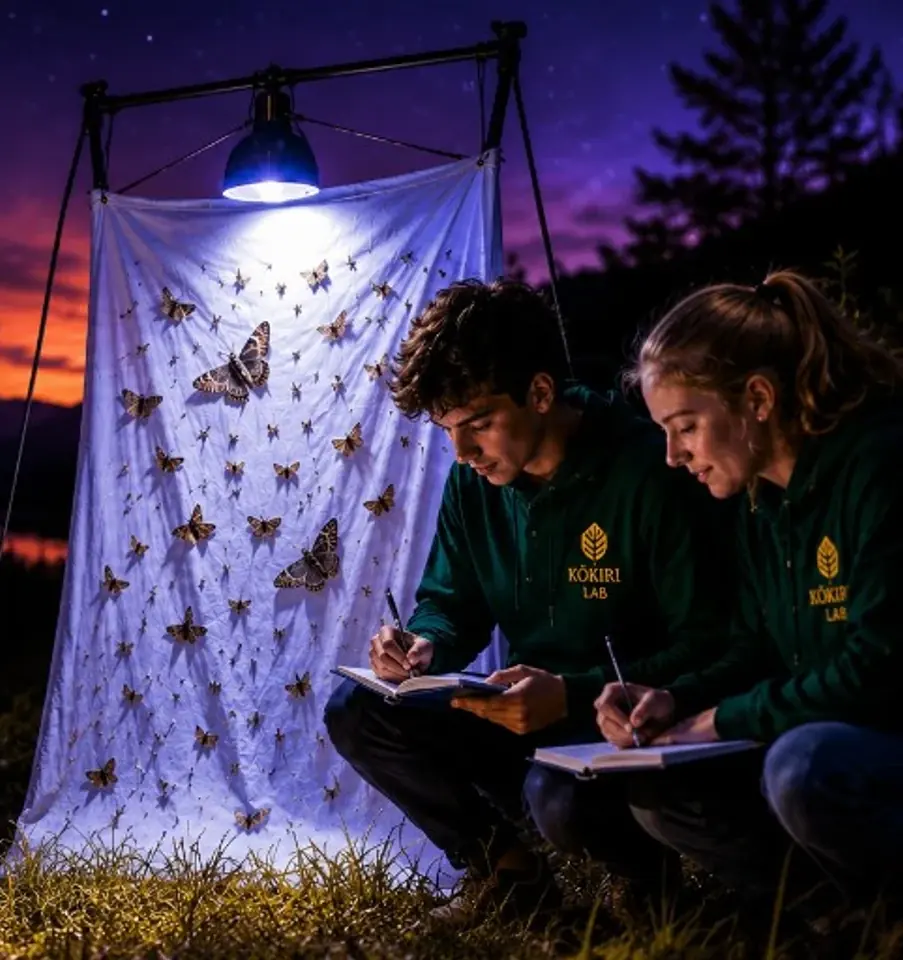
Your platform
No new platform: the Biodiversity & Discovery MaramaTrap data is revisited as longitudinal evidence.
The open light-trap upload is live. The same dataset is revisited later as longitudinal evidence in Evolution & Adaptation.
Open MaramaTrapTaught to the whole combined class. Over the two-year programme the class covers both the Year 7 and Year 8 curriculum statements.
The whole combined Year 7–8 class investigates the same phenomenon, with the same fieldwork, equipment and inquiry problem. Instead of splitting the class by year level, every task has three levels of support (Getting started, On track, Stretch), so each learner goes as deep as they are ready to.
Comparing populations, traits and conditions across time is the central intellectual move this world asks students to make.
All five dimensions recur across every world. Each world provides a context in which one or more becomes especially visible, not an exclusive assignment.
Document 33 stage names, used across Kōkiri. The week plan above shows which stages each week works in.
Te reo groupings shown are provisional, pending cultural advisor review.
Mainly in STEM Investigate and Think & Create.
Kite · te reo group (provisional)
Whakaaro · te reo group (provisional)
Mainly in Make & Test, ending with Explain in Share & Impact.
Wero · te reo group (provisional)
Kite · te reo group (provisional)
Whakaaro · te reo group (provisional)
Auaha · te reo group (provisional)
Tohu · te reo group (provisional)
Moa, tuatara, kākāpō, kea, and the history of introduced species in Aotearoa, following the curriculum's own example set.