
Evidence-claim linkage
- Starting out
- What evidence supports this claim?
- Going further
- How strong is the evidence, what alternative explanations remain, and what evidence would change our conclusion?
World 08 · Any term · Combined Year 7–8 class
Can we build a world that behaves like a real system?
Your mission
World Builders: can we make a world that behaves like the real one?
What you'll make
A playable model of a real system, tested against real data, with an honest note of where it fails.
Who it's for
Another class plays your model; whānau showcase
How long
About nine one-hour sessions, in any term. It can be shorter or longer.
NZ curriculum, Years 7–8:Technology: Digital TechnologyTechnology: Design, Make, and Innovate· Topics: computer modelling, Scratch, simulation, predator–prey models, maps, navigation, star compass, systems modelling
Your journey
Tap a week to see that lesson. Each world runs as nine one-hour weeks; it can be shortened to five weeks or stretched to 11–12.
Week 1Open →
What is a model?
Ask · Look closely
VOICE Question · Observe
Week 2Open →
Programming a rule
Collect evidence
VOICE Evidence
Week 3Open →
Choose and research the system
Look closely · Collect evidence
VOICE Observe · Evidence
Week 4Open →
Design the rules
Make sense of it · Say what we found · Decide what's next · Define the problem · Come up with ideas · Sketch the plan
VOICE Interpret · Finding · Next step → FORGE Frame · Options · Represent
Week 5Open →
Build v1
Build it
FORGE Generate
Week 6Open →
Test against reality
Test it · Judge it
FORGE Test · Evaluate
Week 7Open →
Revise
Improve it
FORGE Refine
Week 8Open →
Playtest and refine
Test it · Improve it
FORGE Test · Refine
Week 9Open →
Share
Explain and share
FORGE Explain
5 weeks
Quick build
Change one rule in a starter predator–prey model and test it against real data.
9 weeks
Full journey
Build, test, playtest and explain your own model of a real system.
11–12 weeks
Go further
Add a second system, compare two algorithms, or publish to a class gallery.
Big ideas
A model is a representation of a system, tested against how the real system actually behaves.
Rules, feedback and constraints can be used to represent real relationships.
A model that fails to behave as expected is still a valuable source of evidence.
Up close
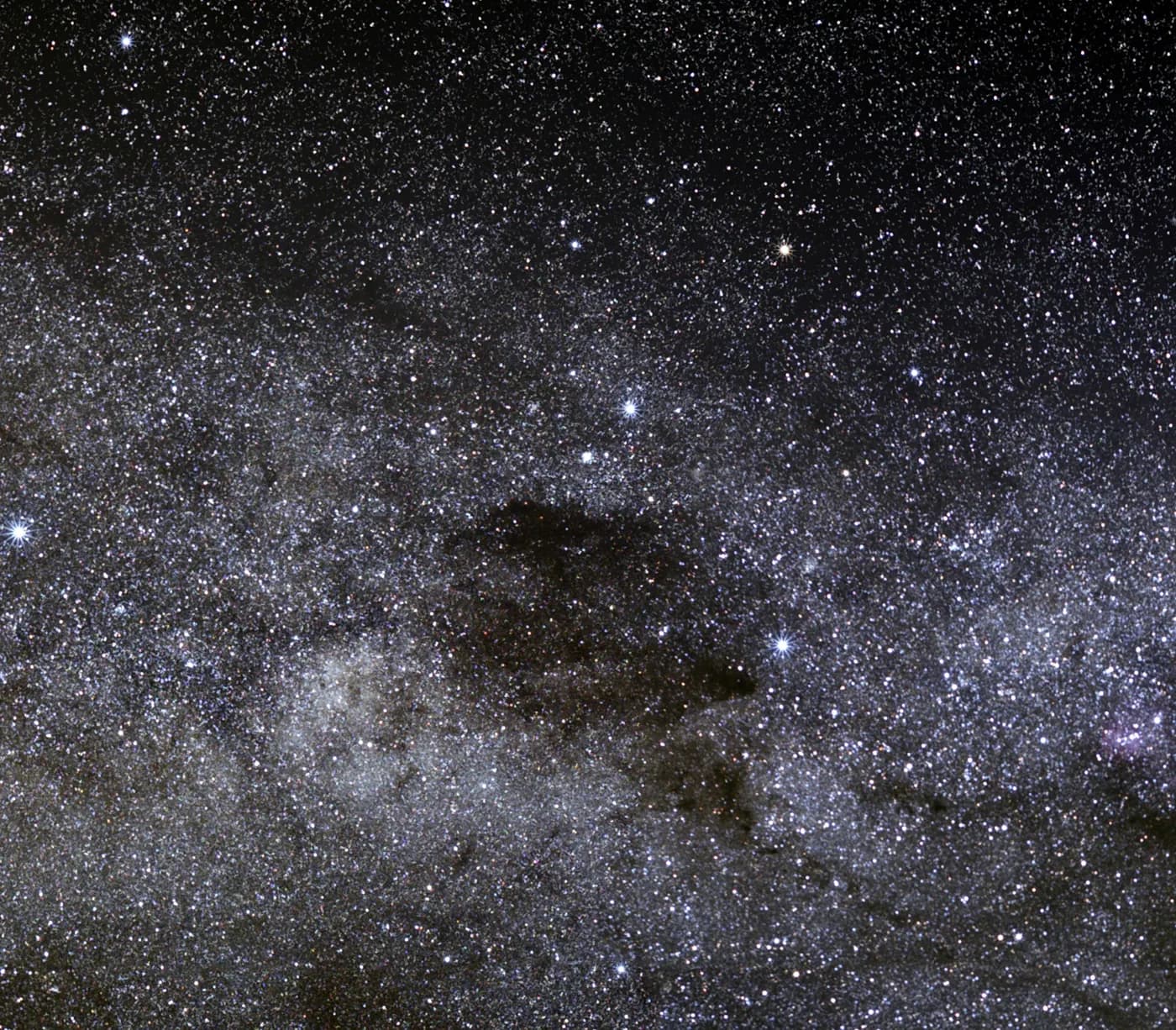
The Southern Cross and the dark Coalsack nebula: stars used for finding south.
Photo: ESO/S. Brunier, CC BY 4.0, via Wikimedia Commons
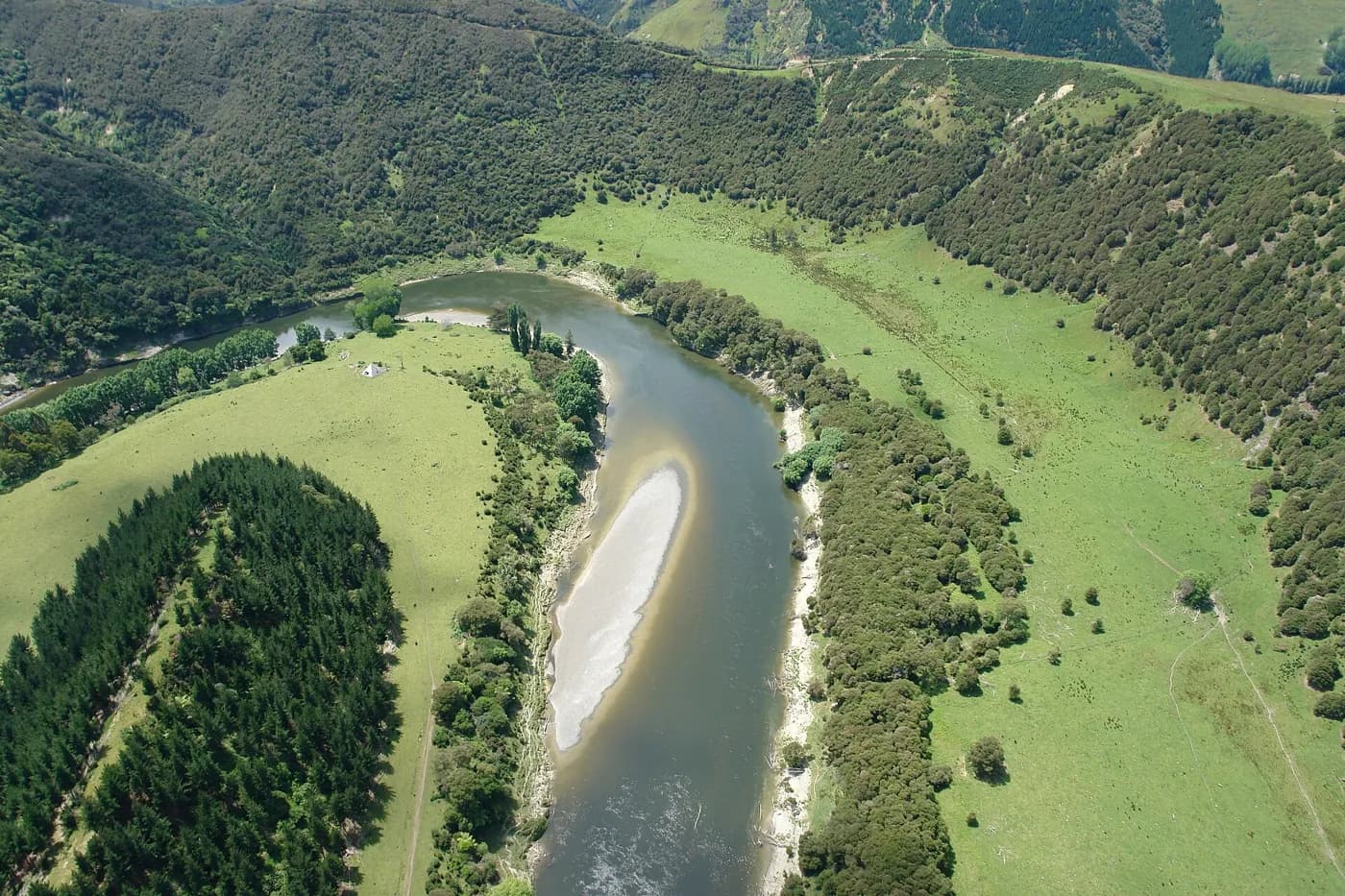
The Whanganui River from the air: a real system you could model and map.
Photo: Duane Wilkins, CC BY 3.0, via Wikimedia Commons
Read first
Nature is full of patterns: the spiral of a shell, the branching of trees and rivers, the cycle of the seasons. Branching patterns spread water or nutrients to every part of a system. Seasonal cycles time when plants grow and animals breed.
When you build a model world, your rules make the patterns. A good model produces patterns that look like the real system.
Think about it: What pattern should your model produce if it is working? How will you know?
Source: Regenpreneur PDC "Pattern Understanding".
A map is a model of a real place. It shows some things and leaves others out. Mapmakers choose:
Think about it: If your model world had a map, which three layers would matter most for your system?
Source: Massey GIS course material, "Map Projections Tutorial" and "Choropleth Mapping Activity".
Topography is the shape of the land. Slope is how steep it is. Gentle slopes (0–5%) drain well and suit farming with machines. Steep slopes (15% and above) erode more easily in heavy rain, so they are often planted with trees whose roots hold the soil. Aspect is the direction a slope faces (in New Zealand, north-facing slopes get more sun).
Think about it: If your model world has hills, what rule would you write for what happens to soil on a steep slope in heavy rain?
Source: Regenpreneur PDC "Understanding and Leveraging Farm Topography".
One more reading draws on mātauranga Māori and will appear once our cultural advisor has checked it.
Go deeper: from Science Learning Hub and DOC
A model is a simpler version of something real (an object, a process or a whole system) that helps us explain it or predict what it will do. Some are things you can hold, like a globe. Some are drawings. Some are sets of rules run on a computer.
Scientists use models when the real thing is too big, too small, too slow, too fast or too far away to study directly. For example:
Every model is wrong in some way. A model is only as good as the data and rules inside it. So scientists test their models against real observations (called ground-truthing), and improve them when new evidence arrives. Globes took centuries to become accurate.
That is exactly what you do in this world: build a model, test it against real data, and say honestly where it fails.
Think about it: What is one thing your model world gets right, one thing it leaves out, and how could you test it against reality?
Adapted for Kōkiri Lab from “Scientific modelling”. Source: Science Learning Hub – Pokapū Akoranga Pūtaiao, The University of Waikato Te Whare Wānanga o Waikato, www.sciencelearn.org.nz Read the original
Explore more
These links open other websites. Kōkiri Lab checked them in September 2026.
How you'll learn
What evidence can we gather?
Students encounter the phenomenon, build the knowledge needed to interpret it, and gather evidence directly.
This is not a strict pipeline. A student may investigate, model, test, investigate again, revise, and communicate, in whatever order the actual inquiry demands.
Make something
Science investigations
VOICE: ask a question and find out with evidence
You need
device with Scratch · starter model
Steps
How you'll know: You can describe the pattern and one way it differs from real life.
Go further: Find real data to compare against.
Fits Week 1 →You need
Scratch model
Steps
How you'll know: Your results support or reject your prediction, and you can say why.
Go further: Find the value that keeps both populations alive.
Fits Week 6 →You need
two maps of your area (street and topographic)
Steps
How you'll know: You can explain why no map shows everything.
Go further: Draw a map of your model world with a legend.
Fits Week 3 →Build projects
FORGE: design, make, test and improve
You need
Scratch or a board-game kit · your research on a real system
Steps
How you'll know: Your model produces a pattern like the real system, and you can say where it fails.
Go further: Add a 'what I left out' panel.
Fits Week 5 →You need
your model · feedback form
Steps
How you'll know: The second group can play it without asking you questions.
Go further: Add instructions inside the game.
Fits Week 8 →You need
model outputs · graph paper or spreadsheet
Steps
How you'll know: A visitor understands your model's main pattern in under a minute.
Go further: Show real data and model data on the same graph.
Fits Week 9 →More ideas from the Kōkiri library
Makerspace build ideas
Ready-made ideas from the Kōkiri maker library that suit the Make & Test part of this world.
Stretch challenges
Where AI helps
Kōkako, your AI mentor
Weeks 6–8, while you test
Our AI promise
Your platform
The specialist platform for building and testing a playable model of a real system.
This section introduces the platform. Its tools are still being built.
Open AraQuestTaught to the whole combined class. Over the two-year programme the class covers both the Year 7 and Year 8 curriculum statements.
The whole combined Year 7–8 class investigates the same phenomenon, with the same fieldwork, equipment and inquiry problem. Instead of splitting the class by year level, every task has three levels of support (Getting started, On track, Stretch), so each learner goes as deep as they are ready to.
A working model has to hold evidence, comparison, revision, uncertainty and systemic logic together at once.
All five dimensions recur across every world. Each world provides a context in which one or more becomes especially visible, not an exclusive assignment.
Document 33 stage names, used across Kōkiri. The week plan above shows which stages each week works in.
Te reo groupings shown are provisional, pending cultural advisor review.
Mainly in STEM Investigate and Think & Create.
Kite · te reo group (provisional)
Whakaaro · te reo group (provisional)
Mainly in Make & Test, ending with Explain in Share & Impact.
Wero · te reo group (provisional)
Kite · te reo group (provisional)
Whakaaro · te reo group (provisional)
Auaha · te reo group (provisional)
Tohu · te reo group (provisional)
Māori navigation, mapping and settlement, and national historical infrastructure; a playable model of Whanganui itself, if the class chooses this as its subject.