
Causal and systemic explanation
- Starting out
- Identify relationships.
- Going further
- Explain interactions, feedback, unintended consequences and system-level effects.
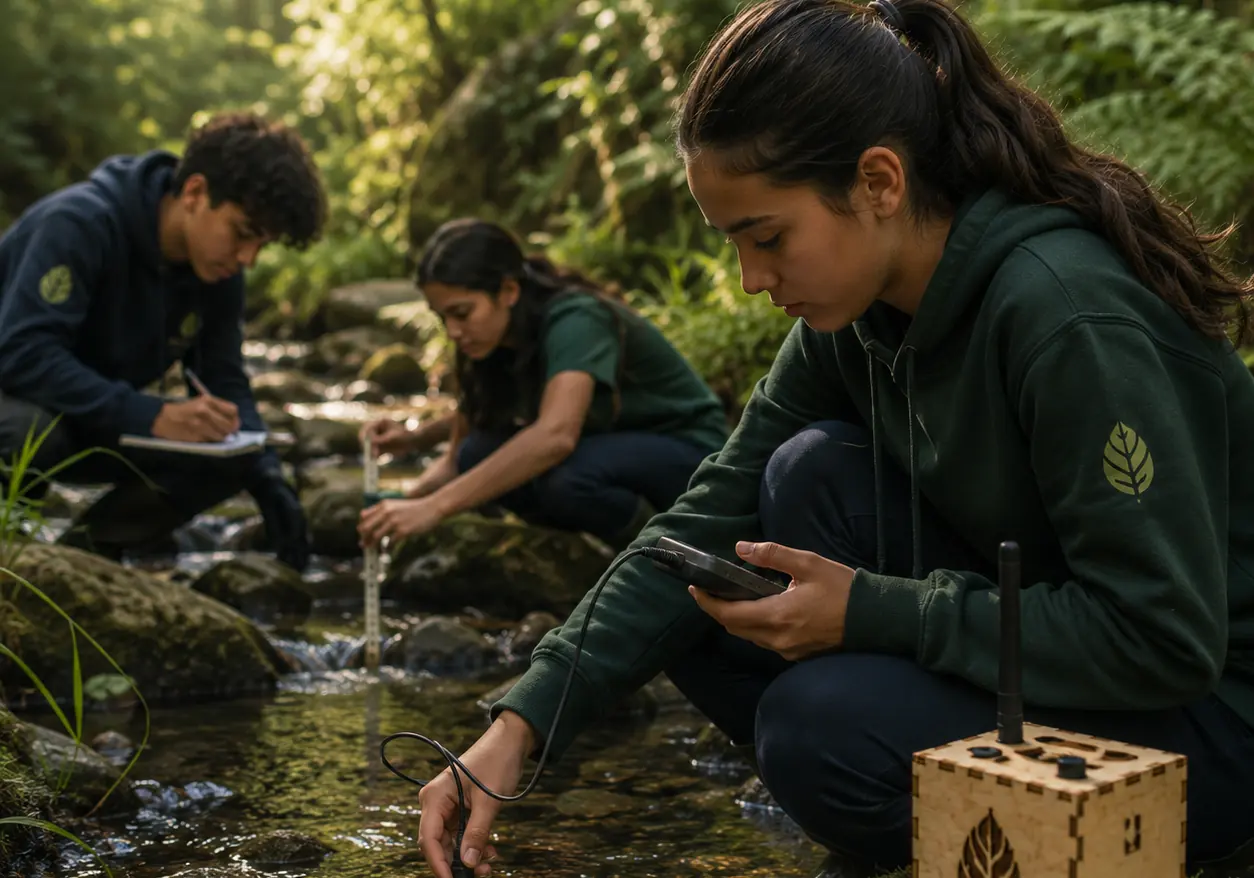
World 03 · Any term · Combined Year 7–8 class
How do we know whether a system is healthy?
Your mission
Awa Health Check: is our stream healthy, and how would we know?
What you'll make
A health check of a real stream or AwaKai tank, with evidence, and a restoration idea you have tested.
Who it's for
Horizons Regional Council freshwater staff, a local restoration group or the school board
How long
About nine one-hour sessions, in any term. It can be shorter or longer.
NZ curriculum, Years 7–8:Science: EcosystemsTechnology: Design, Make, and Innovate· Topics: freshwater ecology, stream health, water quality, macroinvertebrates, food webs, ecosystem restoration, aquaponics, dissolved oxygen
Your journey
Tap a week to see that lesson. Each world runs as nine one-hour weeks; it can be shortened to five weeks or stretched to 11–12.
Week 1Open →
Hook: two waterways
Ask · Look closely
VOICE Question · Observe
Week 2Open →
Who eats whom?
Ask · Look closely
VOICE Question · Observe
Week 3Open →
Measuring the non-living
Look closely · Collect evidence
VOICE Observe · Evidence
Week 4Open →
Field day
Collect evidence · Compare
VOICE Evidence · Compare
Week 5Open →
Making sense
Make sense of it · How sure are we? · Say what we found
VOICE Interpret · Uncertainty · Finding
Week 6Open →
Design a monitoring method
Define the problem · Come up with ideas · Sketch the plan
FORGE Frame · Options · Represent
Week 7Open →
Does it detect change?
Build it · Test it
FORGE Generate · Test
Week 8Open →
Improve the method and plan restoration
Judge it · Improve it
FORGE Evaluate · Refine
Week 9Open →
Diagnosis and proposal
Explain and share
FORGE Explain
5 weeks
Quick build
An AwaKai health check from three measurements, with a “how sure” rating.
9 weeks
Full journey
A stream diagnosis, a tested monitoring method and a restoration proposal for a real audience.
11–12 weeks
Go further
Monthly re-checks, a sensor logger, or a riparian planting with a restoration partner.
Big ideas
An ecosystem is a community of organisms interacting with the biotic and abiotic components of their environment.
Organisms in an ecosystem are interdependent and have roles that cycle matter and transfer energy.
Ecosystem health can be diagnosed through measurable evidence, not assumed.
Up close
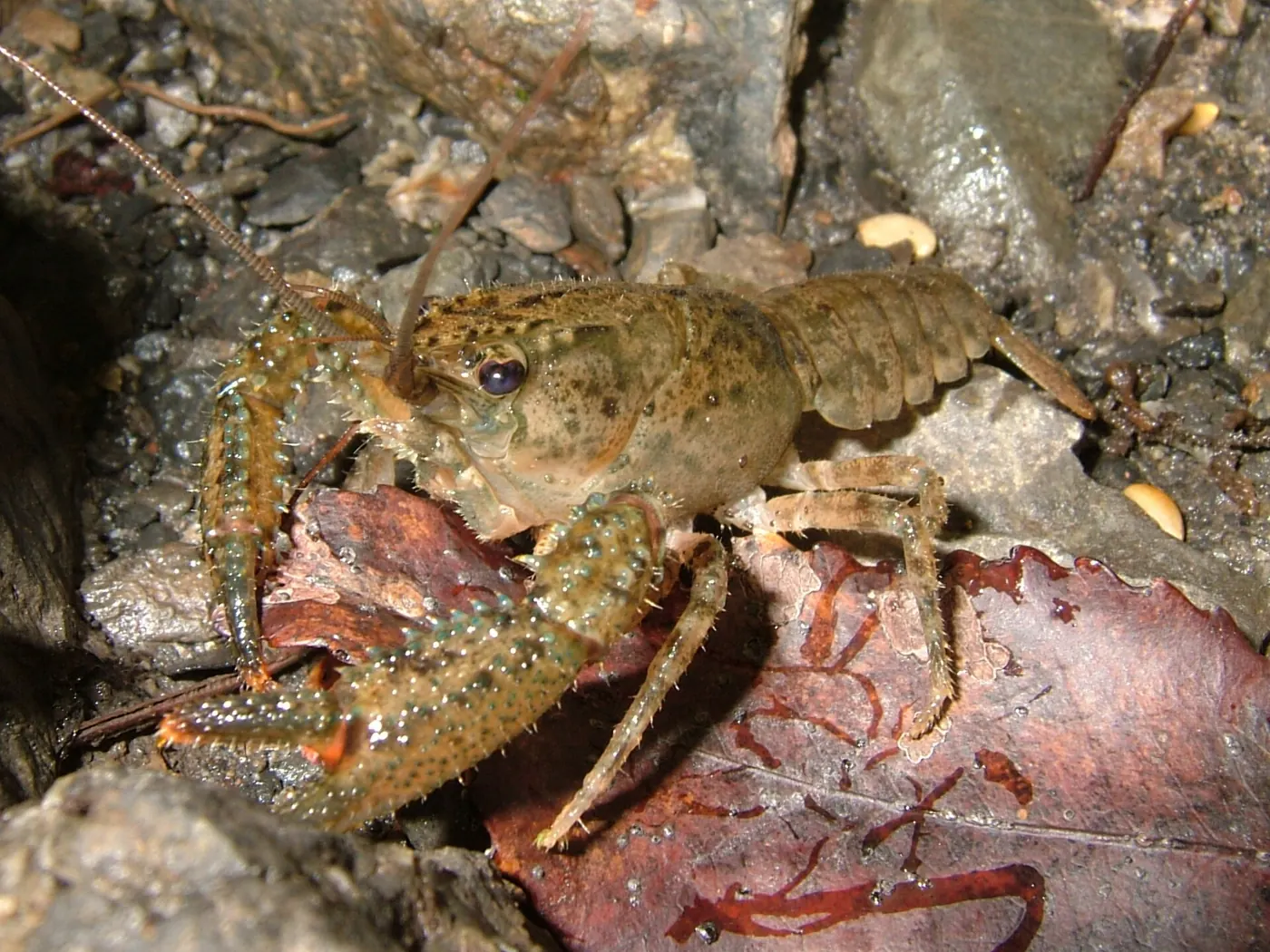
Kōura, the freshwater crayfish: a sign of a stream with good places to hide.
Photo: Gusmonkeyboy, Public domain, via Wikimedia Commons
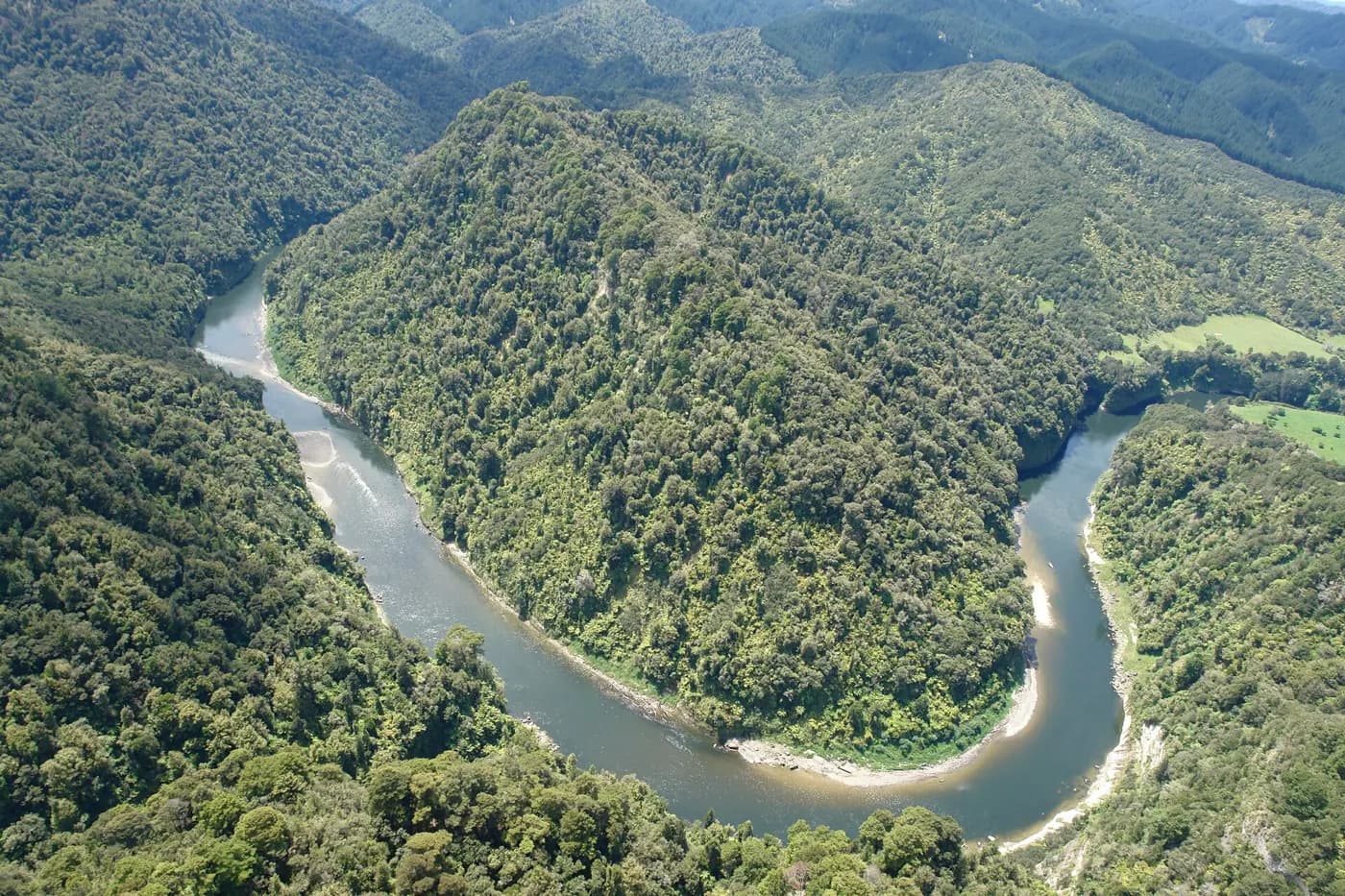
A bend in the Whanganui River, where healthy water starts in the catchment.
Photo: Duane Wilkins, CC BY 3.0, via Wikimedia Commons
Read first
You measure pH (how acid or alkaline the water is) and temperature. One reading is a snapshot; many readings build a picture.
Six steps, tank or stream
Honest science: cheap strips can be out by a bit, so say "strips" in your notes. Tank numbers are not the same as river numbers. Patterns over weeks matter more than one strange reading.
Safety: an adult with you near water, roads and steep banks. Never drink stream water; wash your hands after. Respect private land and any local rāhui.
Source: AwaKai student guide "Checking your water".
Small animals living in the water are bioindicators: living clues about the habitat.
| If you see… | It often suggests… |
|---|---|
| Kōura (freshwater crayfish) | Good habitat: rocks, plants, places to hide |
| Mayfly or stonefly larvae | Cleaner, well-oxygenated water |
| Mostly worms and snails | Enriched or low-oxygen water (note the context) |
| Nothing | Pollution, drought, wrong season or wrong spot: record it honestly |
Kick-net method (with an adult): hold the net downstream, gently kick the stream bed for one minute, tip the catch into a white tray of stream water, sort roughly, and return everything alive.
Think about it: Why might a pond have no mayflies even if it is healthy?
Source: AwaKai student guide "Little animals, big clues".
pH runs from 0 to 14. 7 is neutral; below 7 is acid; above 7 is alkaline. In many school aquaponics tanks, 6.8–7.2 is a common "happy zone". Natural streams vary: bush streams can be naturally more acid. For rivers, trends and context beat one number labelled good or bad.
The nitrogen cycle (aquaponics): fish waste makes ammonia (toxic if too high). Bacteria turn it into nitrite (still risky), then nitrate, which plants use as food. In a balanced tank the waste keeps moving through these stages.
Ask yourself: "If I measured again tomorrow, would I expect the same number? Why or why not?"
Source: AwaKai student guide "Reading the numbers".
Fish and water animals need oxygen dissolved in the water to breathe. Scientists measure it in milligrams per litre (mg/L). Most fish and many invertebrates need more than about 5 mg/L. Below about 1 mg/L, only tough organisms such as some bacteria and "sewage fungus" survive.
How much oxygen water can hold changes:
Oxygen is used up by living things and by rotting material, and topped up from the air and by water plants.
Think about it: On a hot afternoon, would you expect a shallow stream to have more or less oxygen than in the morning? Why?
Source: Massey University study guide "Dissolved Oxygen and Water Quality" (2020 Courses Content / soil and water pollution).
Restoring nature in school grounds works best when students do real, hands-on jobs: planting native plants, making compost, building homes for wildlife, and learning which plants and animals belong there. Inviting local experts (conservationists, botanists, ecologists) and using technology such as cameras and webcams helps too. It builds kaitiakitanga, taking responsibility for the place.
Once, the wetlands of Whanganui were full of life that is now gone, such as the huia and Eyles's harrier. Restoration cannot bring extinct species back, but it can give today's species a better home.
Think about it: What is one restoration action our class could test, and how would we know if it worked?
Source: EcoSchool note "restoring natural areas"; WIS 2024 writing piece "Ancient Whanganui Wetland".
The Bushy Park wasp project shows good restoration science. Before anyone uses poison bait, volunteers put out non-toxic test bait (such as sardines) and count wasp visits. Treatment only goes ahead if there are at least one wasp visit per hour. The stations are placed about every 50 m along the tracks, 1.2–1.5 m up a tree, and every visit is recorded with its location. The bait stations themselves are 3D-printed.
That is a monitoring method: measure before, act only when the evidence says so, then measure again to see if it worked.
Safety: the real wasp baits are toxic and are handled only by trained adults with gloves. Students do the monitoring, not the baiting.
Think about it: Design a "check first" rule for our own restoration idea. What would you count, and what number would make you act?
Source: "Bushy Park Wasp Bait Station User Guide" (Royal Society / Wasp Trap).
Go deeper: from Science Learning Hub and DOC
Streams, rivers, lakes and wetlands make up our freshwater ecosystems. They are home to about 54 native fish species, including galaxiids (whitebait species), bullies, eels, lamprey, torrentfish, smelt and black flounder. They are also home to kōura, ducks and more than 200 species of freshwater macroinvertebrates (animals without backbones that you can see without a microscope).
Scientists often check stream health by looking at the macroinvertebrates. Different species can cope with different water quality, so the mix you find tells you about the water. When you sort them, start by grouping them by features you can see, not by their scientific names.
Look for adaptations too. The water boatman has hairy legs that work like oars, which suits slow-moving water.
Think about it: Draw a simple food web for a stream using at least one fish, one macroinvertebrate and one plant or algae.
Adapted for Kōkiri Lab from “Freshwater ecosystem” by Susan Rapley. Source: Science Learning Hub – Pokapū Akoranga Pūtaiao, The University of Waikato Te Whare Wānanga o Waikato, www.sciencelearn.org.nz Read the original
Aotearoa has native wasps that are not pests. The pests are five introduced social wasps: German wasps (from the 1940s), common wasps (from the late 1970s, now widespread) and three paper wasps.
New Zealand has some of the highest wasp numbers in the world. In some beech forests there are about 12 nests and 10,000 worker wasps per hectare in a season, and together they weigh more than all the native birds, stoats and rodents there.
Wasps eat native insects and newly hatched birds, and take the honeydew that bats, insects, lizards and birds rely on. Their stings can cause allergic reactions.
DOC controls large areas with a protein bait that worker wasps carry back to the nest. It only works in summer, and only trained adults use it.
Think about it: Which of these numbers could our class actually measure, safely, to see whether wasp control is working?
Adapted for Kōkiri Lab. Source: Department of Conservation (NZ), licensed CC BY 4.0. Read the original
Explore more
These links open other websites. Kōkiri Lab checked them in September 2026.
How you'll learn
What evidence can we gather?
Students encounter the phenomenon, build the knowledge needed to interpret it, and gather evidence directly.
This is not a strict pipeline. A student may investigate, model, test, investigate again, revise, and communicate, in whatever order the actual inquiry demands.
Make something
Science investigations
VOICE: ask a question and find out with evidence
You need
thermometer · pH strips · clear jar · kick net · white tray
Steps
How you'll know: Put the chemistry and the creatures together. Sensitive creatures like mayflies plus clear, cool water point to good health.
An adult at the stream. Stay out of deep or fast water. Wash hands after.
Go further: Test upstream and downstream of a drain or farm.
Fits Week 4 →You need
AwaKai tank or two containers · thermometer · dissolved-oxygen test (if available)
Steps
How you'll know: If warmer afternoons usually show less oxygen, your data supports the idea. Note what else changed.
Go further: Graph temperature against oxygen.
Fits Week 3 →You need
food-web cards · string or arrows
Steps
How you'll know: You can explain at least two knock-on effects with arrows.
Go further: Add introduced wasps to a forest food web and trace their effect.
Fits Week 2 →Build projects
FORGE: design, make, test and improve
You need
everyday containers · thermometer · pH strips · clarity tube (a clear bottle and a marked disc)
Steps
How you'll know: Your kit's readings are close to the class kit's on the same water.
Go further: Write instructions a Year 5 could follow.
Fits Week 6 →You need
microcontroller with a waterproof temperature probe · waterproof case
Steps
How you'll know: You have a complete overnight graph with no big gaps.
Keep electronics and cables dry and away from mains power. An adult checks the setup.
Go further: Compare two nights with different weather.
Fits Week 7 →You need
your stream data · poster or slides
Steps
How you'll know: Your proposal links a problem you measured to an action and a way to check it.
Go further: Estimate the cost and who could help.
Fits Week 9 →More ideas from the Kōkiri library
Background learning
Earlier Kōkiri inquiries with learn pages, activities and build ideas that fit this world. They were written before the eight-world curriculum, so use them as background and pick what helps.
Makerspace build ideas
Ready-made ideas from the Kōkiri maker library that suit the Make & Test part of this world.
Stretch challenges
Where AI helps
Kōkako, your AI mentor
Weeks 3–5, with your water readings
Our AI promise
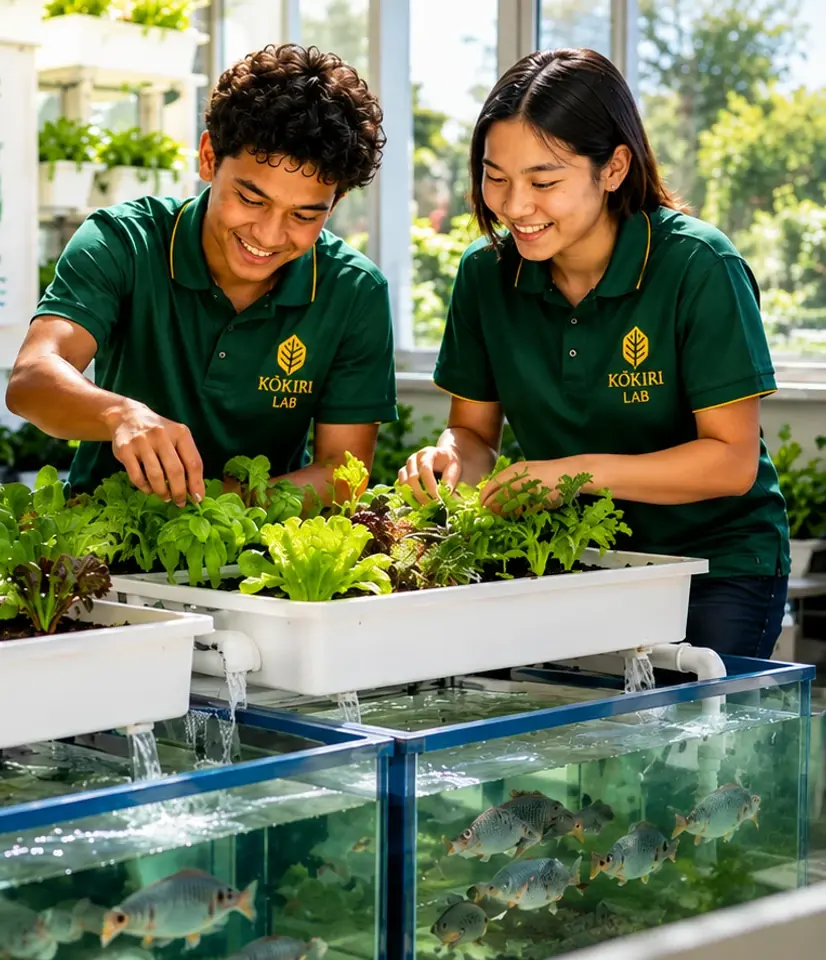
Your platform
Diagnostic mode: gather measurable evidence of whether a water system is healthy.
Both modes use the same open water-reading log: place, region, water source, pH, temperature and notes.
Open AwaKaiTaught to the whole combined class. Over the two-year programme the class covers both the Year 7 and Year 8 curriculum statements.
The whole combined Year 7–8 class investigates the same phenomenon, with the same fieldwork, equipment and inquiry problem. Instead of splitting the class by year level, every task has three levels of support (Getting started, On track, Stretch), so each learner goes as deep as they are ready to.
Diagnosing ecosystem health depends directly on explaining relationships between biotic and abiotic factors.
All five dimensions recur across every world. Each world provides a context in which one or more becomes especially visible, not an exclusive assignment.
Document 33 stage names, used across Kōkiri. The week plan above shows which stages each week works in.
Te reo groupings shown are provisional, pending cultural advisor review.
Mainly in STEM Investigate and Think & Create.
Kite · te reo group (provisional)
Whakaaro · te reo group (provisional)
Mainly in Make & Test, ending with Explain in Share & Impact.
Wero · te reo group (provisional)
Kite · te reo group (provisional)
Whakaaro · te reo group (provisional)
Auaha · te reo group (provisional)
Tohu · te reo group (provisional)
The Whanganui Awa, recognised in 2017 as a legal person under the Te Awa Tupua settlement, the world's first instance of a river granted legal personhood; historical land clearance, hydroelectric development, wetland drainage and restoration efforts.