
Uncertainty handling
- Starting out
- Identify uncertainty.
- Going further
- Distinguish types and sources of uncertainty and explain how they affect a conclusion.
World 02 · Any term · Combined Year 7–8 class
What lives here, and how can we know?
Your mission
Bug Detectives: what lives here, and how sure can we be?
What you'll make
A field guide page that explains how one local creature's features help it survive, and your verdict on how far to trust the AI that identifies moths.
Who it's for
Bushy Park Tarapuruhi volunteers, the school environment group or a Year 5–6 class
How long
About nine one-hour sessions, in any term. It can be shorter or longer.
NZ curriculum, Years 7–8:Science: Organism DiversityScience: Life ProcessesTechnology: Design, Make, and Innovate· Topics: biodiversity, moths, light traps, invertebrates, adaptations, classification keys, cells and microscopes, AI species identification
Your journey
Tap a week to see that lesson. Each world runs as nine one-hour weeks; it can be shortened to five weeks or stretched to 11–12.
Week 1Open →
Hook: the hidden majority
Ask · Look closely
VOICE Question · Observe
Week 2Open →
Adaptations and a fair survey
Ask
VOICE Question
Week 3Open →
Field day
Look closely · Collect evidence
VOICE Observe · Evidence
Week 4Open →
Sort and key
Compare
VOICE Compare
Week 5Open →
Cells up close
Look closely · Collect evidence
VOICE Observe · Evidence
Week 6Open →
Which habitat has more life?
Make sense of it · How sure are we? · Say what we found
VOICE Interpret · Uncertainty · Finding
Week 7Open →
Can we trust the machine?
Test it · Judge it
FORGE Test · Evaluate
Week 8Open →
Field guide pages and adaptation model
Build it · Improve it
FORGE Generate · Refine
Week 9Open →
Share
Explain and share
FORGE Explain
5 weeks
Quick build
A set of three species cards from one habitat, each with an adaptation and how sure the ID is.
9 weeks
Full journey
Compare two habitats, audit the AI, explain an adaptation and make a class field guide.
11–12 weeks
Go further
A second light-trap night, a bug hotel design, or a real contribution to MaramaTrap or Bushy Park.
Big ideas
Living things vary, and that variation can be observed and recorded.
Classification is a way of organising evidence about relationships between organisms.
Cells are the fundamental unit of living organisms and can be specialised for different functions.
Identification involves uncertainty and evidence, not certainty.
Up close
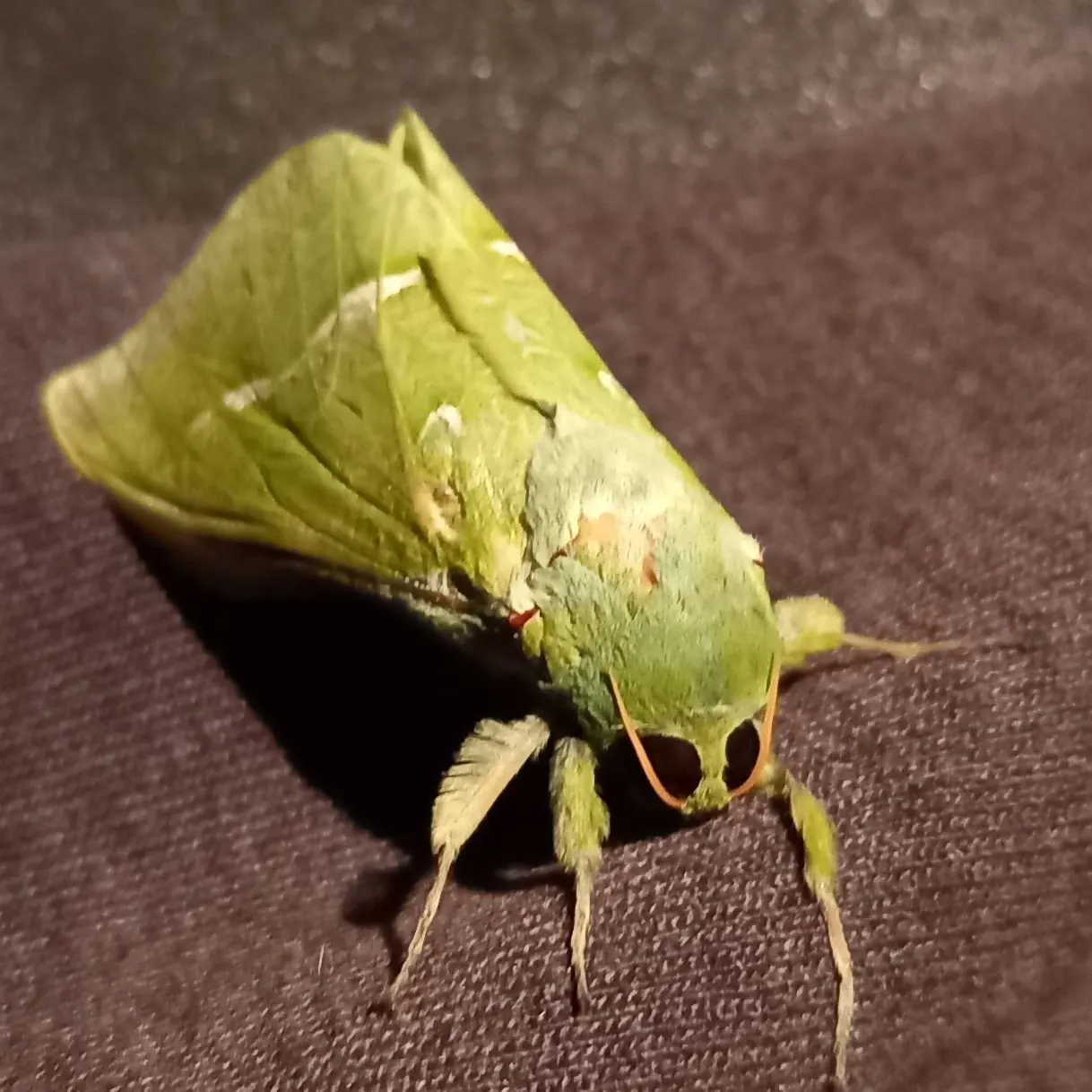
A pūriri moth, Aotearoa's largest moth. It is found only here.
Photo: Kat Jenkins, CC0, via Wikimedia Commons
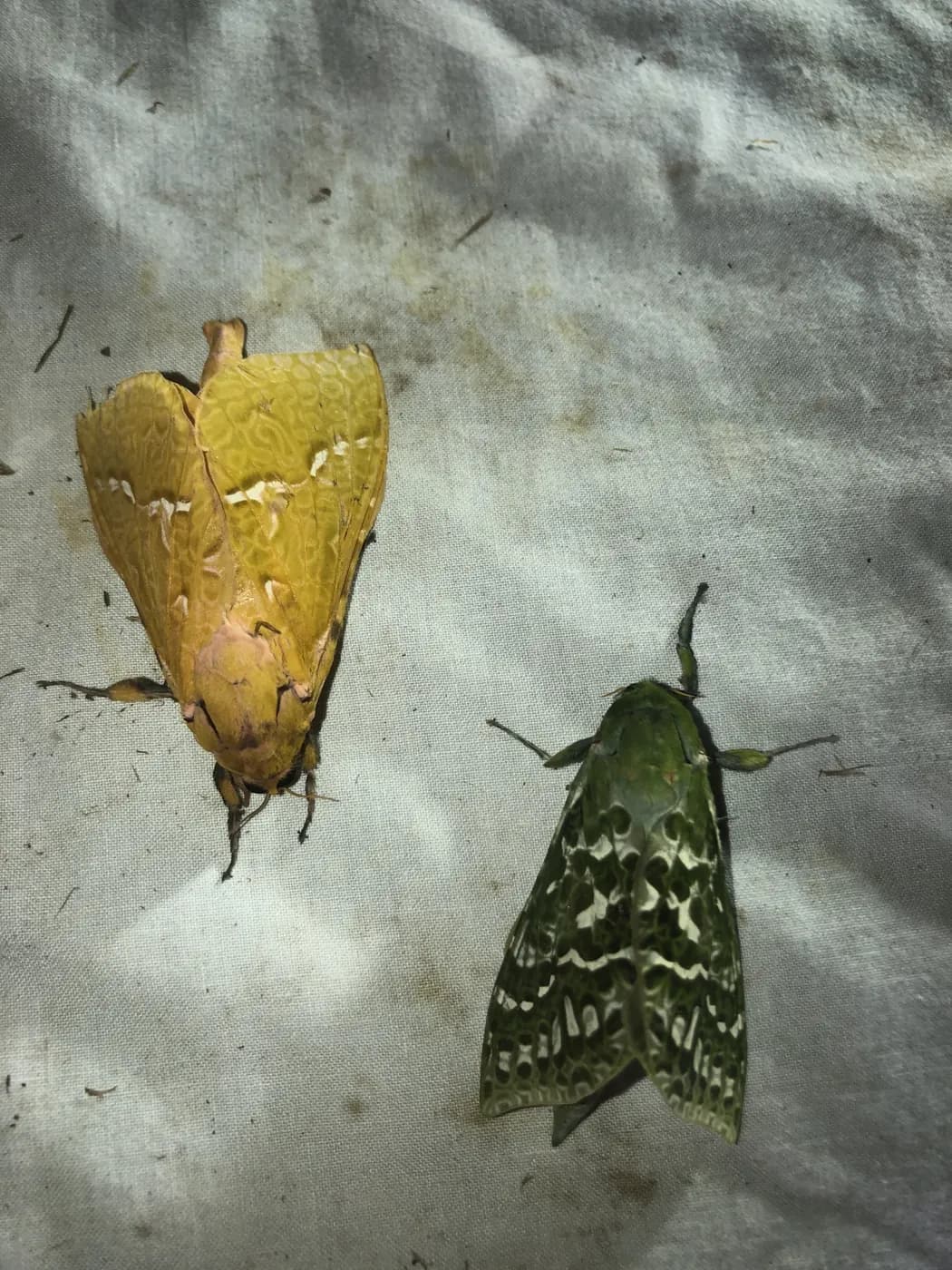
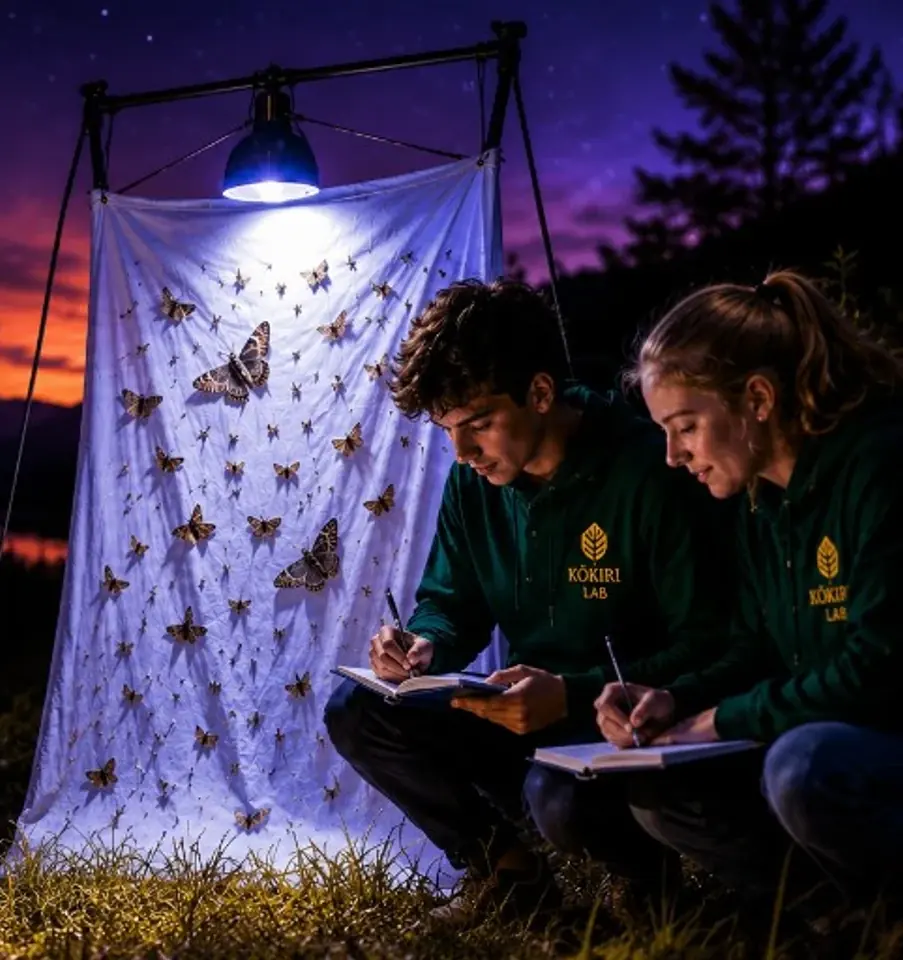
Moths resting on a pale sheet at night, just like a MaramaTrap survey.
Photo: Morgane Merien, CC0, via Wikimedia Commons
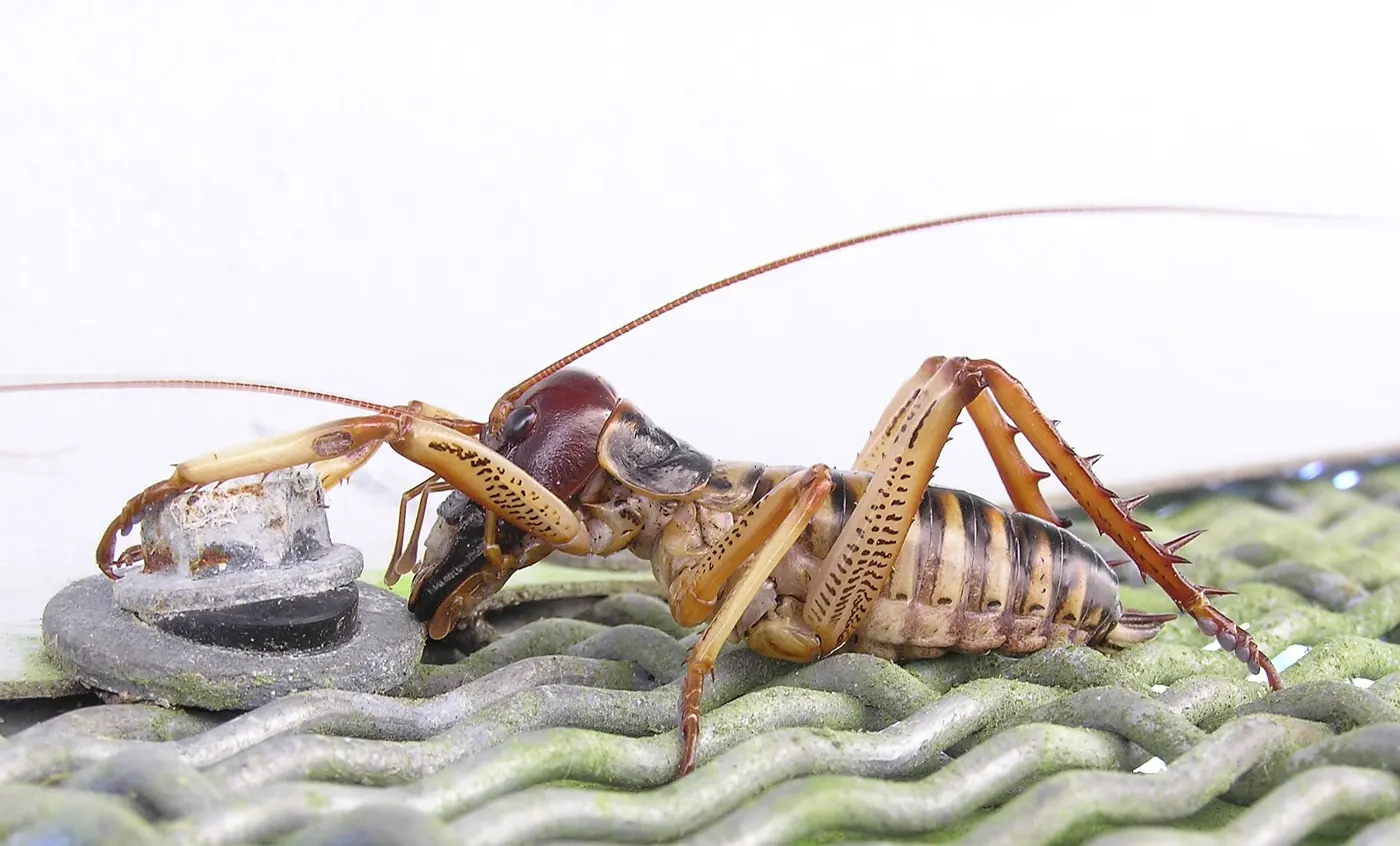
A male tree wētā. Look at the huge jaws and the spiny back legs.
Photo: Tony Wills, CC BY 2.5, via Wikimedia Commons
Read first
You are not catching moths in a jar. You hang a white sheet, switch on a UV torch after dark, and photograph moths when they land. They stay free. You get a photo. Science gets a clue about what lives near your place.
Moths matter because they are food for birds and bats, and their caterpillars eat plants. So moth diversity tells us something about land health.
Setup in seven steps
If nothing shows up, that is still data. Weather, moon phase and season all change moth activity.
Safety: use a 395 nm UV torch, don't shine it in eyes, stay off roads, get permission for private land, and have an adult with you at night.
Think about it: Why is "we saw nothing" still useful evidence?
Source: MaramaTrap student guide "Your first moth night".
MaramaTrap's AI usually names a moth family (a big group of related species), not always the exact species. That is normal, and families are still useful for science.
| Group | Look for | Examples |
|---|---|---|
| Ghost moths (Hepialidae) | Large, sometimes spectacular | Puriri moth, porina moth |
| Hawk moths (Sphingidae) | Chunky body, pointed wings; can hover | Convolvulus hawk-moth (kumara moth) |
| Emperor moths (Saturniidae) | Huge and fluffy; introduced | Gum emperor moth |
| Owlet moths (Noctuidae) | Browns and greys; one of the biggest NZ families | Armyworms, flax-notcher moths |
| Tiger and lichen moths (Erebidae) | Includes the black-and-white magpie moth | Magpie moth |
| Loopers and carpets (Geometridae) | Many hold wings flat like a triangle | Kawakawa looper, cabbage tree moth |
| Grass moths (Crambidae) | Small; sit on grass stems | Kowhai moth |
| Plume moths (Pterophoridae) | Narrow, feathery wings | |
| Bag moths (Psychidae) | Caterpillars live in camouflage bags | Common bag moth |
If the AI says "not sure", the photo may be unclear or the moth may be from a tricky group. Try another angle, or check with your teacher or nzbutterflies.org.nz with an adult.
Think about it: Which group would be easiest to identify from a photo? Which would be hardest? Why?
Source: MaramaTrap student guide "Meet some moth groups".
A moth photo without notes is like one word with no sentence. Your notes turn a picture into evidence. Record:
Same method + good notes = your photo can join a national picture of moth life in Aotearoa.
Think about it: If two groups trap on different nights, what notes would you need to compare them fairly?
Source: MaramaTrap student guide "Why your notes matter".
Scientists have used light to sample night-flying insects for a long time. Light traps mostly catch moths, but also adult water insects like mayflies and caddisflies.
Here is a surprise: light does not attract insects. It confuses them and pulls them off their chosen flight path. Some circle the light; others settle nearby and fly off later.
Insects see green, blue and near-ultraviolet (UV) light very well. They see yellow and orange poorly, and they cannot see red at all. That is why UV torches work.
A light trap mostly samples insects within about 500 m. Wind matters (insects fly upwind, and many settle in strong wind), and so do temperature and humidity. Rain can stop flying altogether.
Think about it: List three things that could change your catch that have nothing to do with how many moths live there.
Source: Department of Conservation, Inventory and Monitoring Toolbox, "Invertebrates: light trapping" (B. Patrick, 2016).
MaramaTrap's AI does two jobs. First, detection: it finds the insect in the photo and draws a box around it. Second, classification: it decides what kind of insect it is.
Each answer comes with a confidence score between 0 and 1. A score of 0.90 means the AI is very sure. A score of 0.35 means it is mostly guessing. A careful system says "uncertain" instead of forcing every photo into a group.
Why moths? New Zealand has about 1,800 described moth species, most found nowhere else. Their caterpillars often need particular plants, so the moths you find tell you about the plants and habitat around you. Moth communities can change within two to five years after habitat restoration.
Think about it: If the AI is 90% sure and your expert is sure it's wrong, who do you believe? What would you check?
Source: UCOL Applied Science, "Image Identification and AI Classification Pipeline" report (2026), Light Trap Study folder. Field results from this study are not yet published and are not quoted here.
New Zealand's biodiversity is special: many species are found nowhere else, because the country was isolated for so long. Living things do jobs for the land: tūī and bellbirds pollinate plants, and predators like the kārearea (NZ falcon) control smaller animals.
Two big threats are habitat loss (native forest cleared for farms) and introduced predators such as rats, stoats and possums. Planting native trees along streams and field edges creates corridors that connect patches of habitat so wildlife can move between them.
Think about it: Which of our two survey habitats has more native plants nearby? Would you predict more moth groups there?
Source: Regenpreneur PDC Module 11, "Farm Biodiversity" (PDC 2025).
New Zealand has thousands of native wasp species. Most are tiny, live alone (solitary), don't build big nests, and help control other insects. The problem wasps are introduced social wasps: the German wasp (arrived 1945) and the common wasp (1970s). They build large papery nests, often underground, and there is nothing here to keep their numbers down.
At Bushy Park Tarapuruhi, near Whanganui, birds such as the toutouwai (North Island robin) and tīeke (saddleback) feed on native insects. Wasps eat huge numbers of the same insects. NZ research found that wasps in infested forests can weigh more in total than all the birds, rats and stoats in the same area, and can remove 1.5–8.1 kg of invertebrates per hectare each year.
Think about it: If wasps eat the insects that robins feed their chicks, what would you predict happens to the robins? What evidence would you collect to check?
Source: "Wasp Control at Bushy Park, Whanganui" recommendation report (2025); "A Guide to Wasp Identification and Control" (Tasman–Nelson). Both in Royal Society / Wasp Trap.
Go deeper: from Science Learning Hub and DOC
New Zealand has more than 2,000 species of moths and butterflies, and over 90% of them live nowhere else. Only 17 are butterflies; about 98% are moths.
Moth or butterfly?
Life cycle: egg → caterpillar (eats and grows) → pupa inside a cocoon → adult. Many adult moths live only one or two weeks.
Some moths to know: the pūriri moth, our largest; Gadira petraula from the South Island, whose females can't fly; and Orocrambus fugitivellus, a moth that flies by day and also has flightless females.
Moths feed native birds and help pollinate plants, and changes in moths can warn us about changes in the environment.
Think about it: Why might flightless females make a moth species more at risk if its habitat changes?
Adapted for Kōkiri Lab from “New Zealand moths”. Source: Science Learning Hub – Pokapū Akoranga Pūtaiao, The University of Waikato Te Whare Wānanga o Waikato, www.sciencelearn.org.nz Read the original
Moths can be nocturnal (active at night), diurnal (by day) or crepuscular (at dusk and dawn). Flying at night means less competition for food and fewer daytime predators.
Moths were flying at night long before electric lights existed. To fly straight, many seem to keep a fixed angle to something far away, like the Moon or stars. Some can also sense Earth's magnetic field.
Scientists aren't completely sure why moths gather at lights, and there are several ideas. A leading one: a moth mistakes a nearby light for the distant Moon. Because the light is close, the angle keeps changing as the moth flies, so it keeps turning, and ends up circling the light. Other ideas are that moths are drawn to particular colours of light, such as ultraviolet.
Light traps use this behaviour to sample moths. Some night-blooming flowers attract moths partly with the carbon dioxide they give off.
Think about it: “Scientists aren't completely sure.” How could our class test one of the ideas about why moths come to lights?
Adapted for Kōkiri Lab from “Nocturnal adaptations of moths” by Angus Gaffney. Source: Science Learning Hub – Pokapū Akoranga Pūtaiao, The University of Waikato Te Whare Wānanga o Waikato, www.sciencelearn.org.nz Read the original
Explore more
These links open other websites. Kōkiri Lab checked them in September 2026.
How you'll learn
What evidence can we gather?
Students encounter the phenomenon, build the knowledge needed to interpret it, and gather evidence directly.
This is not a strict pipeline. A student may investigate, model, test, investigate again, revise, and communicate, in whatever order the actual inquiry demands.
Make something
Science investigations
VOICE: ask a question and find out with evidence
You need
pitfall cups (dry) · trowel · white tray · hand lens · tally sheet
Steps
How you'll know: Compare richness and abundance. Then say how sure you are, and what could have affected the result (weather, how long, where).
Handle with brushes or pots, not bare hands. No kill jars.
Go further: Add a third habitat, like under a tree.
Fits Week 3 →You need
white sheet · 395 nm UV torch · phone camera · notebook
Steps
How you'll know: Moth counts can change with the moon, wind and cold, so note all of them before you decide.
An adult with you at night. Never shine the UV light in eyes.
Go further: Compare the moth families on each night.
Fits Week 3 →You need
10 moth photos with AI results · moth ID guide
Steps
How you'll know: Look for a pattern: are blurry photos or low confidence scores more often wrong?
Go further: Find a photo that fools the AI, and explain why.
Fits Week 7 →Build projects
FORGE: design, make, test and improve
You need
photos or drawings · page template
Steps
How you'll know: Another group identifies the creature correctly using only your page.
Go further: Add a 'look-alike' box that shows how not to confuse it.
Fits Week 8 →You need
clear container or 3D-printed chamber · mesh · leaves and damp tissue
Steps
How you'll know: The insect stays calm and you recorded real behaviour.
Go further: Add a scale ruler so photos show size.
Fits Week 5 →You need
specimen photos or cards · paper
Steps
How you'll know: Someone who hasn't seen your specimens can reach the right name.
Go further: Make it work for 15 specimens.
Fits Week 4 →More ideas from the Kōkiri library
Background learning
Earlier Kōkiri inquiries with learn pages, activities and build ideas that fit this world. They were written before the eight-world curriculum, so use them as background and pick what helps.
Makerspace build ideas
Ready-made ideas from the Kōkiri maker library that suit the Make & Test part of this world.
Stretch challenges
Where AI helps
MaramaTrap moth identifier
Weeks 3 and 7
Kōkako, your AI mentor
Weeks 4–6, while you make sense of your survey
Our AI promise
Your platform
Collect and identify local species, and weigh the AI's confidence against your own.
The open light-trap upload is live. The same dataset is revisited later as longitudinal evidence in Evolution & Adaptation.
Open MaramaTrapTaught to the whole combined class. Over the two-year programme the class covers both the Year 7 and Year 8 curriculum statements.
The whole combined Year 7–8 class investigates the same phenomenon, with the same fieldwork, equipment and inquiry problem. Instead of splitting the class by year level, every task has three levels of support (Getting started, On track, Stretch), so each learner goes as deep as they are ready to.
Species identification is genuinely uncertain, and AI-assisted classification confidence makes that uncertainty directly visible.
All five dimensions recur across every world. Each world provides a context in which one or more becomes especially visible, not an exclusive assignment.
Document 33 stage names, used across Kōkiri. The week plan above shows which stages each week works in.
Te reo groupings shown are provisional, pending cultural advisor review.
Mainly in STEM Investigate and Think & Create.
Kite · te reo group (provisional)
Whakaaro · te reo group (provisional)
Mainly in Make & Test, ending with Explain in Share & Impact.
Wero · te reo group (provisional)
Kite · te reo group (provisional)
Whakaaro · te reo group (provisional)
Auaha · te reo group (provisional)
Tohu · te reo group (provisional)
Māori ecological knowledge, moa and extinction, introduced species, conservation; local biodiversity sites and species around Whanganui.